
If you run a dealership, repair shop, or service department, the choice between dealer decals vs window stickers is not a design decision. It is an operations decision. The right product helps you identify vehicles, reinforce your brand, support service communication, and keep your process consistent across every car that moves through your lot or bay.
These two products can look similar at a glance, but they do different jobs. Choosing the wrong one usually shows up later – poor placement, harder application, shorter lifespan, or a message that does not fit how your team actually uses the vehicle. For busy automotive businesses, that kind of mismatch costs time.
Dealer decals vs window stickers: what is the difference?
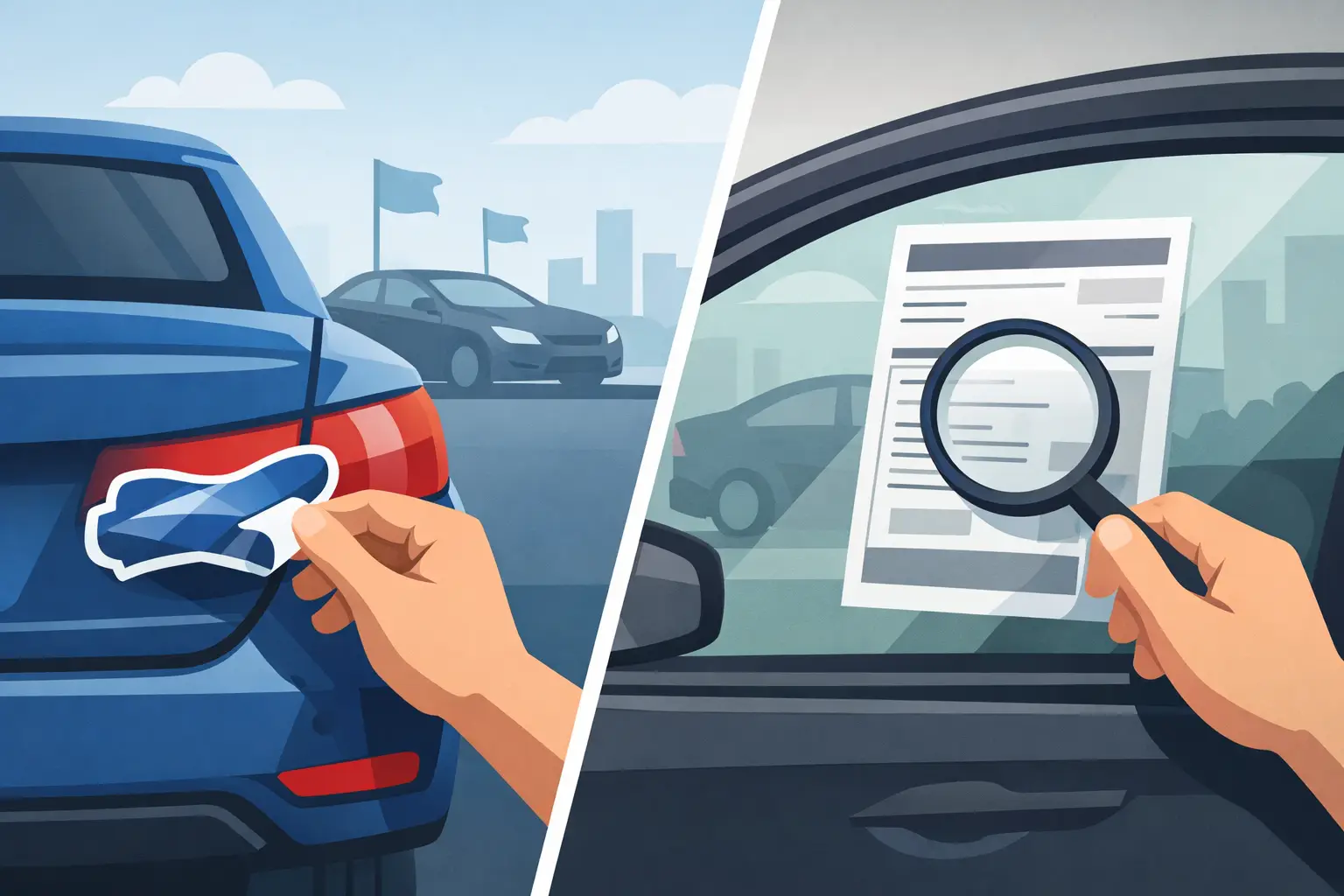
A dealer decal is typically a smaller branding label applied to a vehicle to show dealership identity. You usually see it on the rear window, trunk, tailgate, or bumper area, depending on the material and application style. Its main job is brand presence. It tells people where the vehicle came from and keeps your name visible after the sale.
A window sticker is broader in purpose. It may be used for pricing, stock identification, buyer information, temporary promotions, lot organization, or service-related communication. Some window stickers are meant to face outward for customer viewing on inventory vehicles. Others are used inside the shop or on vehicles in process to communicate status, instructions, or internal notes.
So the simple version is this: dealer decals are usually brand-forward and long-term, while window stickers are often information-forward and may be temporary, semi-permanent, or task-specific.
That said, there is overlap. Some dealers use branded window stickers. Some decals carry more than a logo, such as a phone number or website. What matters most is the use case, not the label.
When dealer decals make more sense
Dealer decals are the better fit when your goal is consistency and long-term visibility. If every sold vehicle leaving your lot should carry your dealership name in a clean, professional format, decals are the standard choice.
They also make sense when placement matters. A properly sized decal can be applied in the same location on every vehicle, which keeps your branding uniform. For dealerships with multiple staff members delivering vehicles, that consistency matters. It prevents the rushed, uneven application that makes one vehicle look polished and the next look like an afterthought.
Material choice matters here. A dealer decal should be durable enough to handle weather, washing, and normal exposure without peeling early or fading too fast. It should also look sharp on a wide range of vehicle colors and body styles. A cheap decal may save money on the order, but it can work against the image you want to present once it starts curling or discoloring.
For service departments, dealer decals can also support retention. A vehicle that carries your name stays in front of the customer long after delivery. It is a quiet reminder of where they purchased or serviced the vehicle.
When window stickers are the better tool
Window stickers are stronger when the message needs to change, move, or serve a process. On inventory vehicles, they are useful for displaying stock numbers, pricing, trim details, financing notes, or promotional messages. In fixed ops, they can help identify vehicles waiting on parts, vehicles ready for pickup, or units assigned to a specific job stage.
This is where flexibility becomes the advantage. A window sticker can be designed around readable information first, with branding added where it supports the message. That makes it more practical than a dealer decal when your team needs communication, not just identification.
Window stickers also work better when visibility from outside the vehicle is important. If shoppers on the lot need to quickly scan details through the glass, or if your staff needs to identify vehicle status from a distance, the format is doing a different job than a small exterior branding decal.
For shops handling a high volume of vehicles, this distinction matters. A product that helps staff identify, route, and communicate saves more than the product cost. It helps reduce mistakes and keeps the flow moving.
The real question is lifespan and purpose
Most confusion around dealer decals vs window stickers comes from assuming both products should perform the same way. They should not.
If the message should stay with the vehicle for months or years, you are usually looking at a decal-style application with durable materials and a permanent adhesive. If the message is tied to inventory, a service event, a temporary notice, or a changing workflow, a window sticker may be the smarter choice.
This is why operational buyers tend to make better decisions than purely marketing-driven ones. They start with the job the product needs to do. A parts manager, service manager, or dealer operations lead usually asks the right question first: how will this be used every day?
That question should guide size, adhesive type, print method, and placement.
Dealer decals vs window stickers for branding
For pure branding, dealer decals usually win. They are cleaner, less cluttered, and better suited to a simple logo, business name, phone number, or short identifier. They do not compete with pricing or vehicle information. They just keep your brand visible.
Window stickers can still support branding, but branding is usually secondary. If a sticker has to carry stock data, disclaimers, promotional copy, or internal notes, your logo becomes one more element fighting for space. That is fine when the sticker is built for communication. It is less effective when your only goal is brand recognition.
A good rule is simple: if the customer should remember your name, use a decal. If the customer or staff needs to read and act on information, use a window sticker.
Application, removal, and day-to-day handling
This is where trade businesses usually separate the useful products from the annoying ones.
Dealer decals should apply cleanly and stay put. If they are difficult to align, tear during installation, or trap air too easily, they slow down delivery prep. If they fail early, they create service complaints you do not need.
Window stickers need a different kind of performance. Some must remove cleanly without leaving adhesive behind. Others need to stay legible under sun exposure while still being easy to replace as inventory changes. If your lot staff or service team handles them daily, speed of application matters just as much as print quality.
There is also the inside-versus-outside question. Some window stickers are intended for interior glass placement and protected from the weather. Others are expected to face more exposure. That changes the material requirements. A product chosen without considering placement often underperforms, even if the print itself looks fine on day one.
Cost is important, but replacement cost matters more
A lower unit price looks good until the product creates extra work. That is especially true for high-volume dealers and service shops.
If a dealer decal fails too soon, reapplication takes labor. If a window sticker smears, curls, or becomes unreadable before the vehicle is sold or processed, staff has to replace it. If the wrong adhesive causes cleanup on glass, that is more labor again. The true cost is not only the print cost. It is how often your team has to touch the same vehicle twice.
That is why dependable materials and consistent production matter. Buyers who order these products regularly are usually not looking for the most creative option. They want the version that works every time.
How to choose the right one for your operation
Start with purpose. If the product is meant to stay on sold vehicles as an ongoing brand marker, choose a dealer decal. If the product is meant to display changing information, support inventory handling, or communicate status, choose a window sticker.
Next, think about who uses it. Sales teams, lot attendants, and service writers all interact with vehicle labels differently. A product that looks good in a mockup but does not fit the workflow will cause friction fast.
Then look at placement, durability, and removal requirements. Exterior branding needs staying power. Interior information displays may need easier replacement. The best choice is the one that matches both the message and the work environment.
For many automotive businesses, the answer is not either-or. It is both. A permanent dealer decal can handle long-term branding, while window stickers handle inventory and service communication. Used together, they cover separate needs without forcing one product to do two jobs badly.
StickerPlanet Canada works with automotive businesses that need these products to perform in real shop and dealership conditions, not just look good on screen. That practical mindset is the right one to bring to your order.
The best printed product is the one your team stops thinking about because it does its job every day, on every vehicle, without slowing anything down.