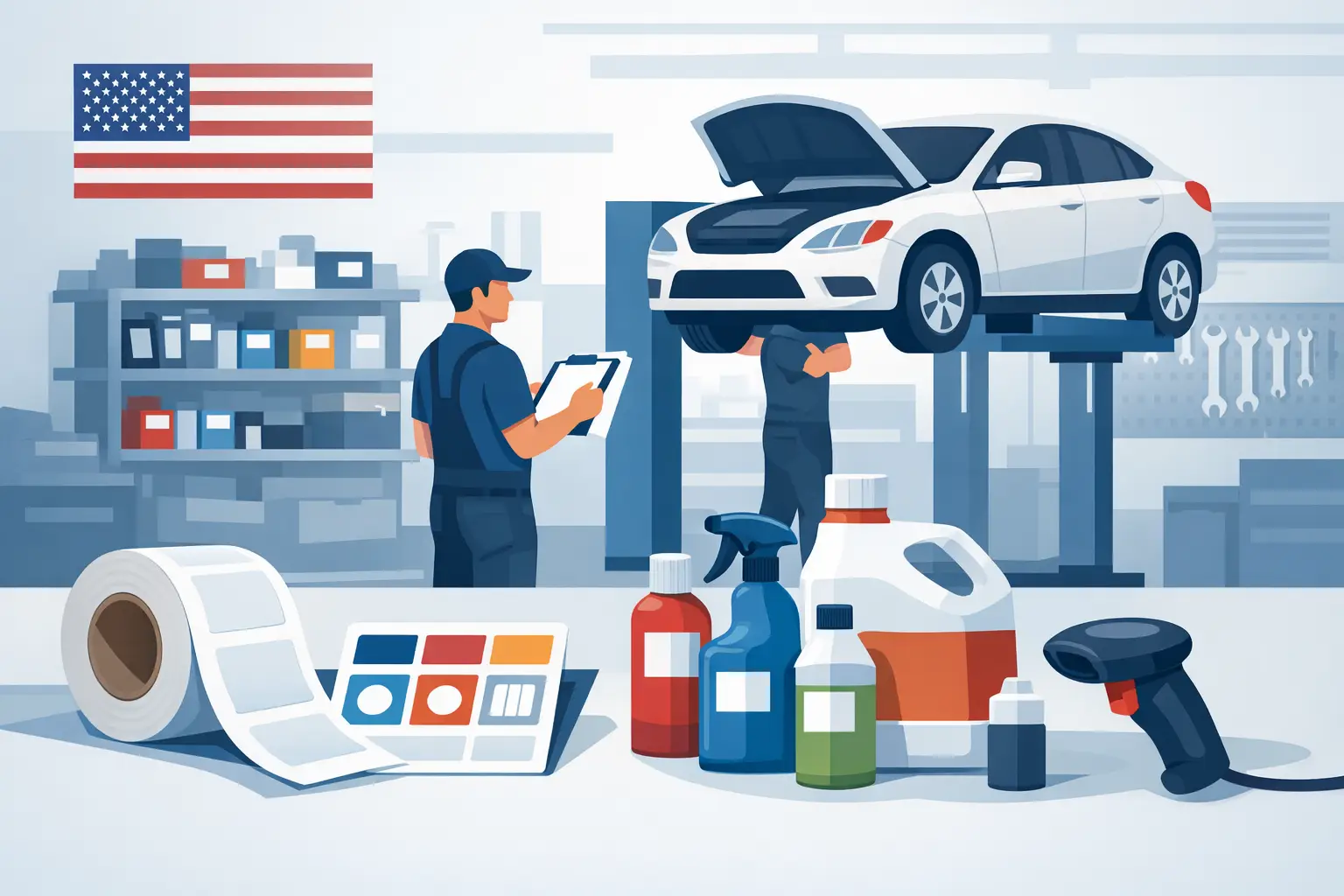
A customer pulls out of your bay with fresh service completed, and what stays with the vehicle after the visit is often a small label. That is why usa auto shop labels matter more than their size suggests. They do real work for repair shops, tire centers, dealerships, oil change locations, and detailing businesses that need every customer interaction to support the next visit.
For most shops, labels are not a nice extra. They are part of the operating system. A reminder sticker on the windshield, a tire re-torque label, a maintenance notice, or a dealer ID label all help keep the service process clear and repeatable. When the print is durable, easy to read, and consistent from one job to the next, the shop looks organized and the customer gets a useful reminder instead of a forgettable handoff.
What USA auto shop labels actually need to do
In a working shop, labels have to perform under real conditions. They get handled by technicians, applied quickly at the counter or in the bay, and exposed to heat, sunlight, moisture, and routine vehicle use. If a label smears, peels too early, or is hard to write on, it stops being helpful and starts creating friction.
That is why the best auto shop labels are built around utility first. They need strong print clarity, dependable adhesive, and materials that fit the application. A service reminder label has different demands than a tire storage sticker or a PDI label. One may need clean removability from glass. Another may need to stay attached in storage or through seasonal handling. Shops that buy on price alone sometimes learn this the hard way when cheap stock creates rework, complaints, or an unprofessional look.
The practical question is not just, “Can we get labels?” It is, “Will these labels hold up in our workflow and support customer retention?” That difference matters.
The shop functions labels support every day
Auto service businesses use labels because they solve specific operational problems. The first is service follow-up. Oil change reminders, tire rotation labels, and maintenance interval stickers give customers a visible prompt long after the receipt is gone. That simple reminder can help bring vehicles back to the same shop instead of letting service drift elsewhere.
The second is internal consistency. Labels help standardize communication between advisors, technicians, and customers. A clearly printed maintenance light sticker or inspection label reduces guesswork. A dealer identification label keeps the business name in front of the customer every time they look at the vehicle. Even smaller items, such as CSI or PDI labels, support process control when volume is high and speed matters.
The third is branding at the point of service. Shops spend money to earn a customer. A well-made label keeps the business visible after the appointment ends. That does not mean overdesigning it. In most cases, a clean logo, contact information, and service date or mileage fields are enough. Function wins, but branding should still be built in.
Choosing the right USA auto shop labels for your operation
Not every shop needs the same label mix. Independent mechanics often need core service reminders and dealer ID labels that keep repeat business moving. Tire shops may lean harder on tire re-torque labels, storage stickers, and seasonal service reminders. Dealership service departments usually need a broader set of printed tools because they are managing volume, compliance, branding, and multiple service categories at once.
This is where it pays to buy based on daily usage rather than broad categories. Think about what your team reaches for every day, every week, and every season. If a product supports a repeated service task, it deserves attention. If it only gets used once in a while, stock quantities and customization options may need a different approach.
There is also a trade-off between generic and custom labels. Generic labels are usually the fastest and simplest option when the goal is straightforward communication. They work well for standard reminders and common service notices. Custom labels add stronger brand presence and can include specific contact details, logos, and layouts that match your process. For many shops, the right answer is a mix of both.
Custom labels vs. stock labels
Custom labels make sense when customer retention and brand consistency are priorities. If your shop wants every service reminder to reinforce your business name, phone number, and recommended return timing, customization gives you better control. It also helps larger operations keep materials aligned across multiple staff members or locations.
Stock labels still have a place because they are practical and efficient. They are easy to reorder, easy to deploy, and often ideal for simple internal or service-use applications. If the information does not change and branding is not essential, stock can be the most cost-effective choice.
Material and adhesive choices matter
This part gets overlooked until there is a problem. The right material depends on where the label goes, how long it needs to last, and whether it needs to remove cleanly. A windshield reminder sticker needs different adhesive behavior than a label used for tire storage or service file handling.
Shops should also think about writing performance. If staff are entering dates, mileage, torque checks, or technician notes by hand, the label surface needs to accept ink cleanly without smudging. Fast-moving service environments do not have time to fight with poor print stock.
Why label quality affects customer retention
Customers notice more than shops think. A crooked, faded, or generic-looking reminder sticker can make the final impression feel rushed, even if the service itself was solid. On the other hand, a clear and professional label signals that the shop is organized and pays attention to details.
That matters because repeat business often comes down to memory and trust. Most drivers are not building spreadsheets to track every service interval. They are glancing at a sticker, seeing the mileage target, and deciding where to go next. If your branding is on that label and the information is easy to read, you have a better chance of earning the return visit.
Labels also support trust by reducing confusion. When a customer can clearly see the next oil change range, re-torque timing, or maintenance note, there is less room for uncertainty. Good labels do not just advertise. They communicate.
Common mistakes shops make with auto shop labels
One common mistake is treating labels like a low-priority commodity. That usually leads to inconsistent sizes, mismatched designs, weak adhesive, or products that are not suited to the application. A few cents saved per roll can disappear quickly if labels fail in use or create a poor customer impression.
Another mistake is overcomplicating the layout. Too much information makes labels harder to read, especially on small formats. Keep the most important fields obvious. Business name, contact details, date, mileage, and service type usually do the heavy lifting. If everything is emphasized, nothing is.
The third mistake is buying without thinking about reorder cycles. Shops run smoother when core print items are standardized and easy to replenish. If labels are essential to your daily process, supply interruptions slow people down. Reliable production and quick turnaround matter more than many buyers expect, especially during seasonal rush periods.
What to look for in a print supplier
A supplier for usa auto shop labels should understand shop use, not just printing in general. That means knowing the difference between reminder products, dealer identification labels, tire service labels, detailing reminders, and process stickers used by service departments. A general printer can make labels. A specialized supplier understands why they are used and what can go wrong.
Speed matters, but not by itself. Shops need quick production, dependable quality, and materials that perform consistently from order to order. They also need options. Some buyers want custom layouts with logos and contact information. Others need proven stock formats that can be reordered without extra setup.
That practical mix is where a focused automotive print supplier stands out. StickerPlanet Canada, for example, is built around repeat-use service print for automotive businesses, which is exactly what many shops need – not novelty products, but dependable tools that support daily operations.
Make labels part of the process, not an afterthought
The shops that get the most value from labels are the ones that build them into the workflow. Service reminders should be applied consistently. Tire labels should match the service being performed. Dealer ID labels should carry the same brand presentation every time. When labels are used consistently, they support both efficiency and retention.
It also helps to review your label lineup once or twice a year. Service menus change, seasonal work shifts, and branding gets updated. Small print items often stay in circulation longer than intended, even after phone numbers, messaging, or service priorities have changed. A quick review can keep your materials aligned with the way your shop actually operates now.
The strongest labels are not the flashiest ones. They are the ones your team uses without friction and your customers notice when it counts. If a label helps the next appointment happen, reinforces your brand, and holds up in daily use, it is doing exactly what it should.