
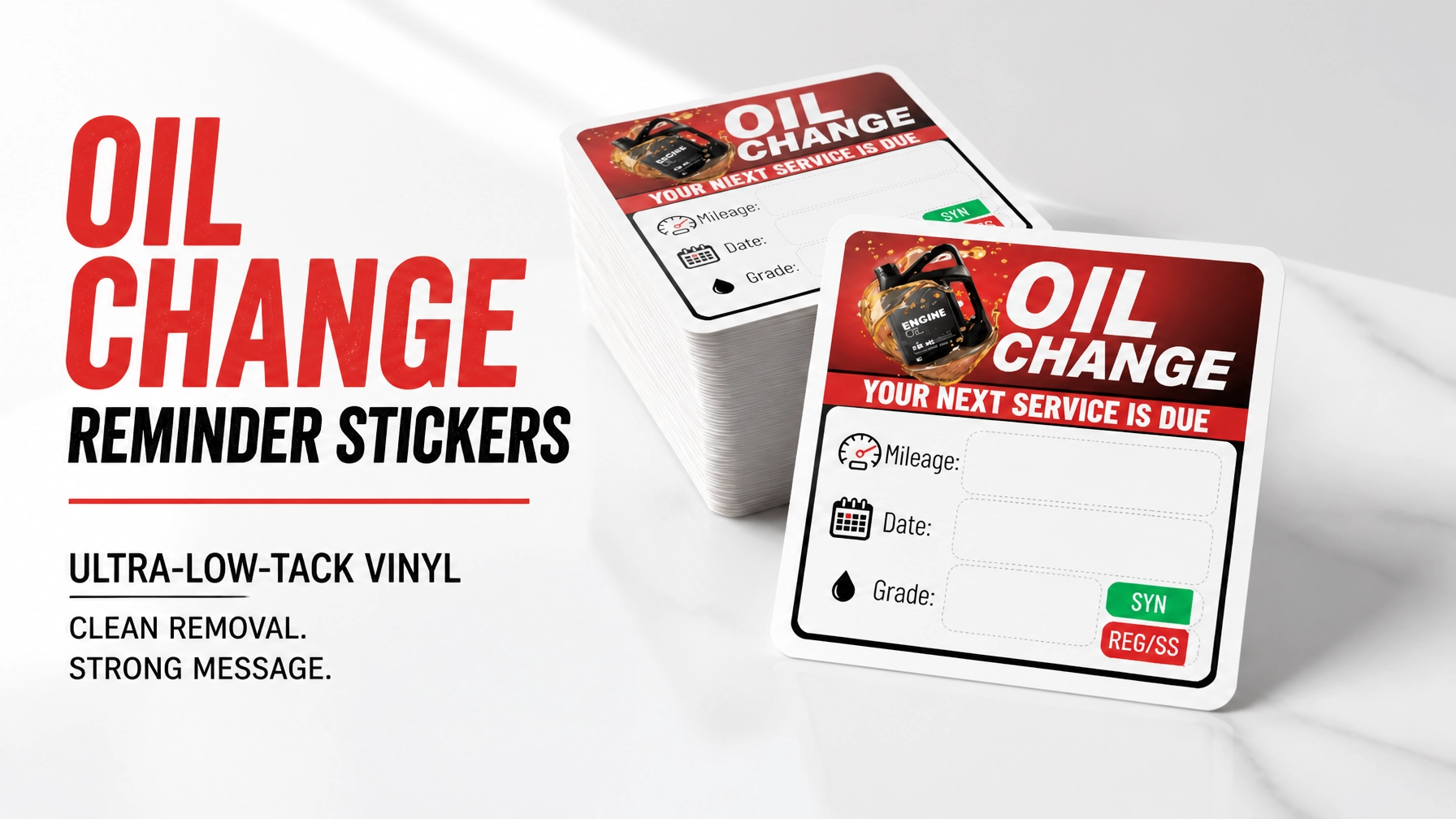
Generic oil change stickers are a practical way to remind customers when their next service is due. They give the driver a visible reference after leaving the shop and help keep your business connected to the next maintenance visit.
However, the sticker only works when your team uses it consistently.
A low-quality material, incomplete information, unreadable handwriting, or poor customer explanation can make a reminder ineffective. Canadian shops also need to use kilometres, not miles, and should make sure the sticker supports: not replaces: a proper service handoff.
StickerPlanet.ca generic oil change stickers use a clear, professional red-and-white layout with fields for mileage, date, and oil grade. They are manufactured using white ultra-low-tack vinyl and eco-solvent inks for durable, readable printing and clean removal from glass when used correctly.
Here are seven common mistakes and the practical fix for each one.
1. Choosing the wrong sticker material
The sticker may look good when it is first applied, but the wrong material can create problems during removal or exposure to changing temperatures.
Common material mistakes include:
- Using ordinary paper labels on a windshield
- Choosing a permanent adhesive when the sticker is intended for temporary service information
- Using material that curls, tears, or leaves adhesive residue
- Selecting a sticker that is difficult to read in bright sunlight
- Assuming every low-tack product has the same performance
A windshield reminder should be designed for its actual application. It needs to remain visible through normal vehicle use while allowing the shop or customer to remove it cleanly later.
The fix
Use white ultra-low-tack vinyl for a professional windshield reminder. It provides a clean writing surface and is better suited to temporary automotive applications than ordinary paper.
StickerPlanet.ca uses eco-solvent inks for all stickers. This printing process produces sharp, high-contrast graphics that support easy reading from the driver’s seat.
Before ordering, confirm:
- The material is intended for inside-windshield use
- The adhesive is ultra-low-tack or otherwise designed for clean removal
- The printed fields are large enough for technicians to complete
- The ink and finish are suitable for the application
For additional material guidance, review the automotive reminder sticker material guide.
2. Leaving important fields incomplete
A sticker with only one number and no context can create more confusion than clarity.
For example, writing “120,000” without identifying whether it means the current odometer reading or the next service reading leaves the customer guessing. A date should also be included because some vehicles reach a time-based service interval before reaching the kilometre interval.
The oil grade is another important detail. A generic oil change sticker should help the customer remember whether the service used synthetic or regular/semi-synthetic oil.
The fix
Use a consistent shop-wide process. At minimum, record:
- Next service odometer reading in KM
- Next service date
- Oil grade or oil type
- Any relevant service note on the invoice or customer record
The generic StickerPlanet.ca design includes dedicated areas for Mileage, Date, and Grade, including SYN and REG/SS selections.
When completing the mileage field, write the next service kilometre reading, not merely the vehicle’s current reading. Record the current odometer reading separately on the invoice or work order.
Do not use a default interval for every vehicle. Check the manufacturer’s recommendations, oil type, vehicle condition, and driving use before writing the next service point.
3. Using illegible handwriting
A reminder sticker is not useful if the customer cannot read it.
Rushed handwriting is especially common during busy periods. Small numbers, unclear zeroes, missing commas, and poorly formed dates can lead to incorrect assumptions. Faded pens and unsuitable markers create additional problems.
The fix
Set a simple handwriting standard for every technician and service advisor:
- Use a dark, permanent pen suitable for the sticker surface
- Write in clear block letters and numbers
- Make every digit large enough to read from the driver’s seat
- Write the unit as KM when appropriate
- Check the completed sticker against the work order before returning the keys
A quick second-person check can prevent avoidable errors. The employee handing back the vehicle should confirm that the date, next service kilometre reading, and oil grade are visible.

4. Applying the sticker inconsistently
Even a well-designed sticker loses value when customers cannot predict where to find it.
Some technicians place reminders in different windshield corners. Others apply them to the dashboard, steering wheel, sun visor, or an area hidden by a tint band. These inconsistent locations make the sticker easier to miss and may create a safety issue.
The fix
Use one standard location:
- Apply the reminder to the inside face of the windshield
- Position it in the top-left corner
- Keep it readable from the driver’s perspective inside the cabin
- Never place it on the steering wheel
- Do not position it where it obstructs the driver’s view
The sticker should be approximately 2 inches by 2 inches. It should remain visible without creating an unnecessary obstruction.
For Canadian vehicles, the steering wheel is generally on the left side. The reminder should still be placed on the inside top-left portion of the windshield, not directly in front of the driver’s line of sight.

5. Writing miles instead of kilometres
Canada uses kilometres for vehicle distance. A sticker that says “next service at 75,000” without a unit can be misunderstood, especially when a vehicle has been imported from the United States or has a dashboard that can display either miles or kilometres.
Using miles on a Canadian customer’s reminder can result in the wrong service timing.
The fix
Make KM the standard unit in your shop.
Your team should:
- Confirm whether the vehicle display is showing kilometres or miles
- Convert the reading when necessary
- Write “KM” beside the next service reading
- Avoid unexplained numbers such as “5,000” or “75,000”
- Cross-check the written value against the invoice
The sticker is a customer-facing instruction. The unit must be clear.
Do not automatically write 5,000 KM for every vehicle. The correct interval can vary according to the manufacturer, oil grade, vehicle age, driving conditions, towing, short trips, and severe winter use.
6. Omitting shop contact information
A generic reminder without shop identification misses an important retention opportunity.
The customer may remember that an oil change was completed but forget which location performed the work. If the sticker contains no name, phone number, website, or other identifying information, the customer has less reason to return to your shop.
The fix
Use a generic sticker that still provides a professional service reminder, then support it with clear shop identification through:
- The printed invoice
- The service record
- A receipt or email confirmation
- A stamp or approved shop contact label where appropriate
- A custom version when your team needs the business name and phone number directly on the sticker
A custom design can include your shop name, phone number, website, logo, and service message. A generic sticker is often the economical choice for shops that need stock immediately, serve multiple locations, or want a standardized reminder format.
Read more about the difference between the two options in custom vs. generic oil stickers.
7. Treating the sticker as a substitute for the customer handoff
The sticker is a reminder. It is not a complete service explanation.
A customer should not have to interpret a number on the windshield without understanding what it means. The service advisor should explain the next recommended interval and identify whether the reminder is based on kilometres, date, or whichever occurs first.
The fix
Use a short, repeatable handoff script:
- “Your next oil service is recommended at ___ KM or ___ date, whichever comes first.”
- “We used synthetic / regular-semi-synthetic oil.”
- “The reminder sticker is on the inside top-left of the windshield.”
- “Your invoice includes the current odometer reading and today’s service details.”
- “Follow the vehicle manufacturer’s recommendations if they differ.”
The team should also confirm that the vehicle’s oil-life monitor has been reset when applicable. The sticker, invoice, dashboard reminder, and customer explanation should communicate the same information.
Seven-point error and fix checklist

Keep this checklist at the service counter:
| Error | Fix |
|---|---|
| Wrong material | Use white ultra-low-tack vinyl |
| Incomplete fields | Record next KM, date, and oil grade |
| Illegible handwriting | Use clear, dark block lettering |
| Inconsistent placement | Apply inside the windshield, top-left |
| Miles instead of KM | Use kilometres and label the unit |
| Missing contact information | Provide shop name and contact details |
| Sticker replaces the handoff | Explain the interval and next step |
A practical way to standardize the process
A consistent process does not need to be complicated:
- Confirm the current odometer reading.
- Check the manufacturer’s recommended interval.
- Confirm the oil type and grade.
- Complete the next service KM and date fields.
- Apply the approximately 2-by-2-inch sticker inside the top-left windshield area.
- Compare the sticker with the invoice.
- Explain the reminder before returning the vehicle.
Generic stickers are most effective when they are part of a documented workflow.
StickerPlanet.ca manufactures professional-grade reminder stickers in Canada using premium materials and eco-solvent inks. Standard orders are supported by fast 2-business-day shipping with tracking and insurance. Pricing is transparent, with no hidden costs. Ask about the right generic or custom format for your shop before ordering.
For more service-label guidance, see how to use oil change reminder labels or explore StickerPlanet.ca’s automotive sticker collection.