
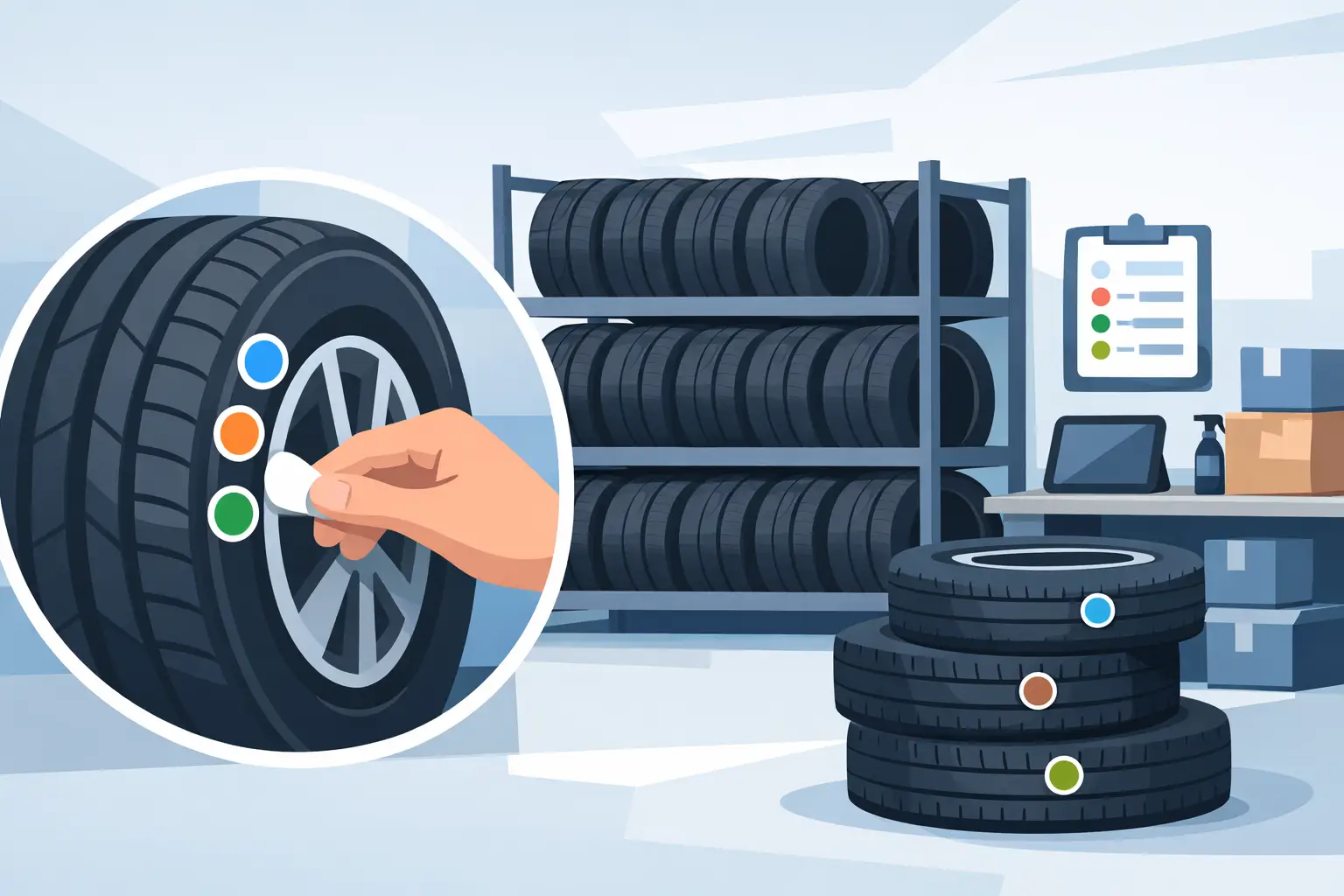
Every seasonal tire rush exposes the same weak spot in shop workflow: a stack of customer tire sets, a rushed write-up at the counter, and one missing detail that turns retrieval into a time-wasting search. Tire storage stickers solve that problem in a simple, repeatable way. They give your team a clear system for identifying stored sets, tying them to the right vehicle, and keeping customer information visible when volume picks up.
For tire shops, repair facilities, and dealerships, this is not a minor office supply. It is an operational tool. When storage season gets busy, small labeling mistakes turn into delays at pickup, internal confusion, and customer frustration that could have been avoided with a durable, easy-to-read sticker.
Why tire storage stickers matter in day-to-day operations
If your shop stores tires for customers, you are managing inventory whether you call it that or not. Each set needs to stay connected to a vehicle, a customer, a storage location, and often a service date or seasonal note. Without a consistent label, your team ends up relying on memory, handwritten shorthand, or whatever system made sense in the moment.
That works until it does not. Similar vehicle names, repeat family customers, worn handwriting, and rushed handling can all create mix-ups. A proper tire storage sticker gives your staff a fixed place to record the details that matter. It also creates consistency across the counter, the service bay, and the storage area.
There is also a customer-facing benefit. Organized labeling supports a more professional handoff. When a customer returns months later and your team can quickly pull the correct set, it reinforces trust. Shops earn repeat business through service quality, but they also keep it through organized execution.
What information should go on tire storage stickers?
The best tire storage stickers are built around real shop use, not extra fields that nobody fills out. In most cases, you want enough space for the basics: customer name, vehicle make and model, plate or unit reference, storage date, and a location code. Some shops also add tire size, season, or a note about wheel position if that matters to their process.
The right layout depends on how your shop actually stores inventory. If your team racks tires by row and shelf, location becomes critical. If you separate by customer account number or repair order, the sticker should support that first. A label that looks complete but does not match your workflow will not save time.
This is where practical design matters. You want a format that is readable at a glance, easy to write on, and large enough for service advisors and technicians to use quickly. Too small, and handwriting becomes a problem. Too cluttered, and the sticker gets ignored.
Keep the layout simple enough to use under pressure
A busy service desk does not have time for overbuilt forms. During tire season, your staff may be processing one vehicle after another with little margin for rework. A clean sticker with clearly marked fields is more valuable than a complicated label with every possible data point.
Simple also helps with training. New staff can follow the process faster when every sticker uses the same format and every field has a purpose. That consistency reduces skipped information and makes the storage system easier to maintain over time.
How tire storage stickers reduce costly mix-ups
The direct cost of a labeling mistake is labor. Someone has to stop what they are doing, search for a set, cross-check paperwork, and possibly move other tires to find the right one. During a peak changeover period, that disruption adds up fast.
The indirect cost is harder to measure but just as real. Customers notice when their pickup is delayed or when your team seems unsure about their stored set. Even if the issue gets fixed, the experience can make your operation look less organized than it actually is.
Tire storage stickers reduce those problems by creating a visible chain of information. When the label is attached properly and filled out consistently, the set can be identified without guesswork. That shortens retrieval time, lowers internal friction, and helps your front-end team communicate with confidence.
There is a limit, of course. A sticker is not a complete storage system by itself. If your inventory process is inconsistent or your storage locations are not mapped clearly, labels alone will not fix that. But as part of a solid process, they do a lot of heavy lifting.
Choosing tire storage stickers for a professional shop
Not all labels hold up the same way in a shop environment. Tires move through service bays, storage rooms, racks, and loading areas. They pick up dust, moisture, and handling wear. If the sticker lifts, smears, or becomes unreadable, the value is gone.
That is why material quality matters. A shop-grade label should be durable enough for seasonal handling and dependable enough to stay legible over time. Adhesion matters too, but it has to be balanced. You want the sticker to stay in place during storage without becoming a nuisance during removal, depending on where and how it is applied.
Print quality is equally important. Crisp lines and clearly defined write-in fields make a difference when your team is moving fast. Generic office labels may seem cheaper at first, but if they are not designed for this use, the savings disappear in wasted time and replacement orders.
Stock versus custom tire storage stickers
For some shops, a stock tire storage sticker is the right call. It is fast, straightforward, and built around the common information most service departments need. If your process is already standardized, a ready-made format may be enough.
Custom versions make more sense when your operation has specific requirements. That could mean including your logo, adding internal tracking fields, matching an existing service form system, or reserving space for a storage location code your team already uses. Customization is not about making the sticker look fancy. It is about making it fit your workflow so staff use it correctly every time.
A good supplier should be able to support both options without making the process complicated. Speed matters, especially before seasonal demand hits.
Using tire storage stickers as part of a better workflow
The biggest gains happen when labels are tied to a repeatable process. The sticker should be completed at the same point in every transaction, by the same role when possible, and attached in a consistent location. That removes uncertainty for everyone who handles the stored set later.
It also helps to pair the sticker with a basic location system. Even a simple rack-row-position format can make retrieval much faster when it is written clearly on the label and used consistently across the storage area. Shops do not always need expensive software to improve storage handling. Often they need a cleaner physical process.
If you are already using service reminder products like oil change stickers, tire re-torque labels, or rotation reminders, this should feel familiar. Tire storage stickers serve the same purpose at a different point in the customer cycle. They support follow-through, reduce missed details, and make the service experience more consistent.
That consistency matters most when volume spikes. A process that feels unnecessary on a slow day becomes essential when the lot is full and every bay is booked.
A small print item with real business value
It is easy to underestimate labels because they are inexpensive and simple. But in a trade business, small printed tools often carry more operational value than their cost suggests. Tire storage stickers help protect labor time, reduce preventable mistakes, and support a more professional customer experience.
They also scale well. Whether you store a modest number of customer sets or manage high seasonal volume, the same basic principle applies: clear labeling supports faster handling. The more inventory you manage, the more that consistency pays off.
For shops that want dependable printed products built around real service department needs, suppliers that specialize in automotive labels tend to understand the details better. StickerPlanet Canada is one example of that practical approach, with products designed for repeat-use shop environments where clarity and fast turnaround matter.
If your tire storage process still depends on memory, marker notes, or whatever label happens to be nearby, there is a better way to run it. A well-designed sticker will not make noise, take up space, or require training manuals. It just helps your team stay accurate when accuracy matters most.