
A crowded counter area can slow down service fast. When customers are unsure where to stand, staff end up repeating directions, lines drift, and the entry area starts to feel disorganized. Social distancing floor stickers solve that problem in a simple, visible way by telling people exactly where to wait, where to line up, and how to move through the space.
For service businesses, retail locations, dealerships, and waiting areas, that kind of clear direction matters. Good floor graphics reduce confusion, support safer spacing, and make the operation look more under control. They are not complicated, but the right material, message, and placement make a real difference.
Why social distancing floor stickers still matter
A lot of businesses first bought floor decals to respond to immediate health rules. That was the starting point, but the value goes beyond temporary compliance. Clear floor messaging helps manage foot traffic, sets customer expectations, and reduces crowding near service desks, payment counters, reception areas, and entrances.
This is especially useful in high-turnover environments. Auto service shops, oil change centers, detail bays, tire shops, and dealership service departments often have short customer interactions packed into busy periods. People come in, ask questions, pay invoices, wait for pickup, or line up at the counter. If there is no visual direction, spacing breaks down quickly.
Well-placed floor stickers give staff support without adding another task. Instead of constantly telling customers to step back, wait here, or follow a line, the floor does some of that work. That saves time and creates a more professional customer experience.
What makes effective social distancing floor stickers
Not every sticker designed for the floor performs the same way. In a business setting, appearance matters, but function matters more. The decal has to stay down, stay readable, and hold up under traffic.
The first factor is material. Floor graphics need an adhesive designed for foot traffic and a surface finish that is appropriate for indoor walking areas. A sticker that works fine on a wall or window will usually fail on the floor. Curling edges, fading print, and premature peeling turn a simple safety tool into a maintenance issue.
The second factor is readability. Customers should understand the message in a second or two. That usually means short wording, strong contrast, and a layout that can be seen from standing height. Arrows, footprints, circles, and spacing markers often work better than text-heavy designs.
The third factor is size. Too small, and the sticker gets missed. Too large, and it can interfere with the flow of the area or look oversized for the space. The right size depends on how far away a customer sees it and how much floor area you want to define.
Where floor stickers work best
Social distancing floor stickers are most effective when they are used at decision points. These are the places where customers stop, pause, line up, or change direction.
Reception counters are one of the most common applications. A simple “please wait here” marker helps keep a clear gap between the counter and the next customer. Entry doors are another strong placement because they set expectations immediately.
Queue lines benefit from repeated spacing markers rather than one sticker alone. If a business expects more than two customers to line up, the spacing needs to continue backward through the waiting area. In larger retail or showroom spaces, directional arrows can also help guide traffic one way through aisles or around service desks.
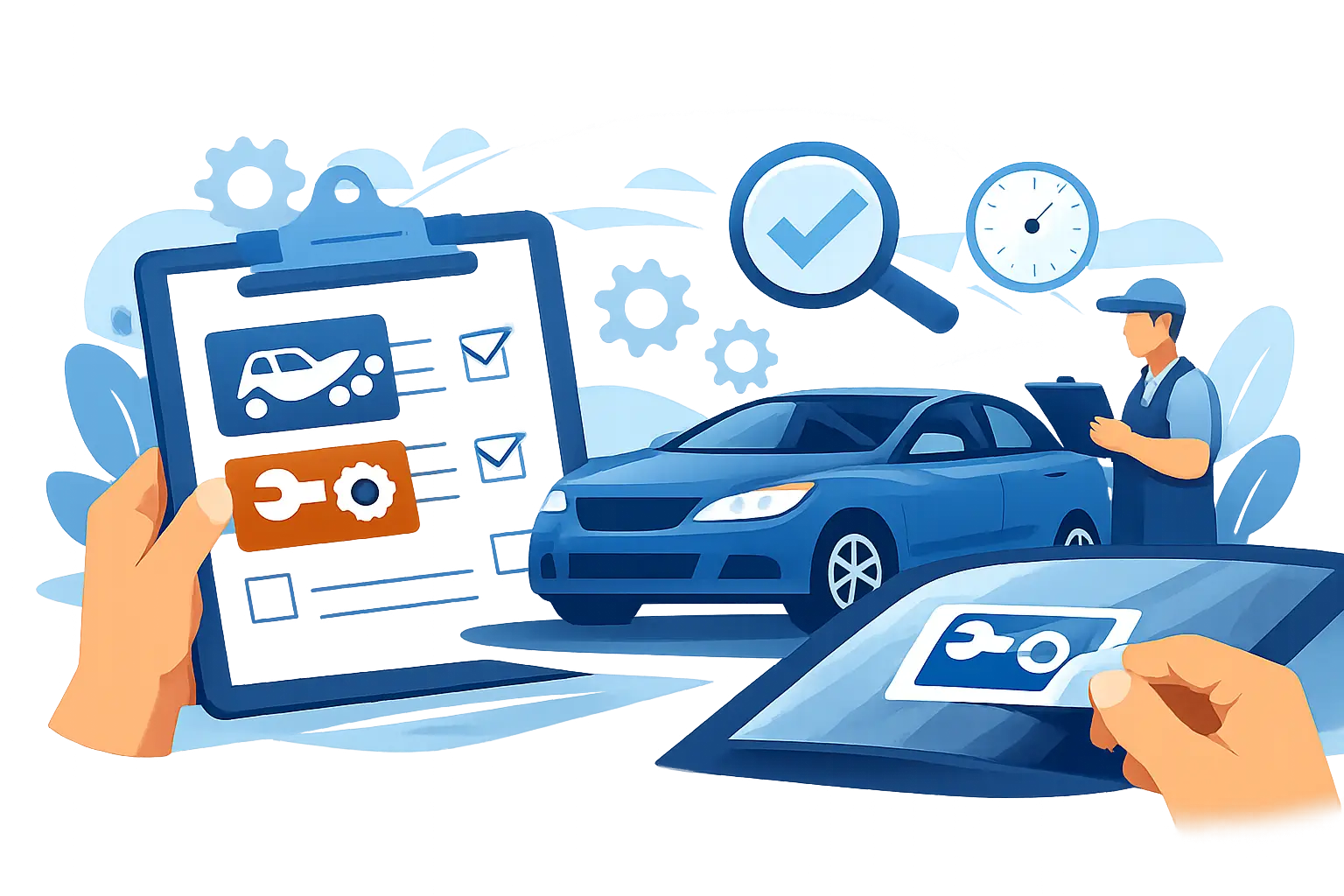
In automotive service settings, the most practical placements are usually customer-facing interior floors rather than production areas. Waiting rooms, payment counters, parts counters, customer pickup zones, and service reception areas are where clear visual communication has the most value.
Choosing the right message for your space
The best wording depends on how formal or direct you want the communication to be. Some businesses need a straightforward instruction such as “Stand Here” or “Please Wait Here.” Others prefer a softer customer-service tone, especially in showroom or hospitality-focused environments.
The key is not to overcomplicate the message. A floor sticker is not the place for a paragraph. A short instruction paired with a strong visual usually performs best.
For some operations, branded messaging also makes sense. Adding a company logo or matching brand colors can help the sticker look like part of the business rather than a temporary add-on. That matters in customer-facing spaces where appearance affects trust. It also helps larger organizations keep signage consistent across multiple locations.
There is a trade-off, though. Heavy branding should never reduce readability. If the customer has to stop and study the sticker, it is doing too much.
Material and durability matter more than most buyers expect
Buyers often focus first on price, but replacement frequency is where cost adds up. If a cheap decal starts lifting after a short period, the real cost is higher because staff have to remove it, clean the floor, and apply a replacement.
Durable social distancing floor stickers are built for repeated foot traffic and daily cleaning. That matters in commercial settings where floors are swept, mopped, and walked on all day. Surface texture also matters because the graphic needs to remain safe underfoot while keeping the print clear.
Floor type plays a role too. Smooth sealed surfaces usually give the best results. Rough, dirty, or textured flooring can affect adhesion. Before ordering large quantities, it is smart to think about the actual installation surface and traffic level. A decal used in a quiet office lobby may not be the right specification for a busy service counter with constant traffic.
Installation affects performance
Even a high-quality floor graphic can fail early if it is installed poorly. The floor should be clean, dry, and free of dust, oil, or residue before application. In automotive-related businesses, that detail matters even more because entrance areas can collect moisture, dirt, and shop debris quickly.
Placement should also be deliberate. Stickers need enough open space around them to remain visible. If they are tucked under a door swing, pushed against a fixture, or placed where customers naturally step around them, they lose value.
Staff should also know why each decal is placed where it is. If furniture, stanchions, or display racks get moved later, the floor messaging may stop making sense. A quick review of traffic flow before installation can prevent that problem.
When custom floor stickers make more sense than stock designs
Stock social distancing floor stickers work well for many businesses, especially when speed matters and the message is standard. They are simple to order and easy to deploy across one or more locations.
Custom options make more sense when the space has a specific traffic pattern, when branding needs to be consistent, or when a business wants to combine spacing messages with other operational instructions. For example, a service department may want decals that direct customers to a pickup desk, cashier point, or waiting zone while still reinforcing spacing.
This is where an experienced print supplier adds value. The product is straightforward, but getting the size, finish, message, and layout right saves time later. StickerPlanet Canada serves businesses that need practical print products built for daily use, and that same approach applies to floor graphics – dependable materials, clear communication, and quick production when timing matters.
A small product that supports a better operation
Social distancing floor stickers are not a major capital purchase, and they are not meant to be complicated. Their value comes from doing a simple job well. They organize space, reduce repeated verbal instructions, and help customers move through your business with fewer questions.
That makes them useful far beyond short-term policy changes. If your business has a counter, a queue, a waiting area, or any point where customers gather, clear floor graphics can improve the day-to-day flow in a way staff notice immediately.
The best choice is the one that fits your traffic, holds up to your environment, and communicates clearly at a glance. When a floor sticker does that, it stops being just a sign on the ground and starts working like part of the operation.