
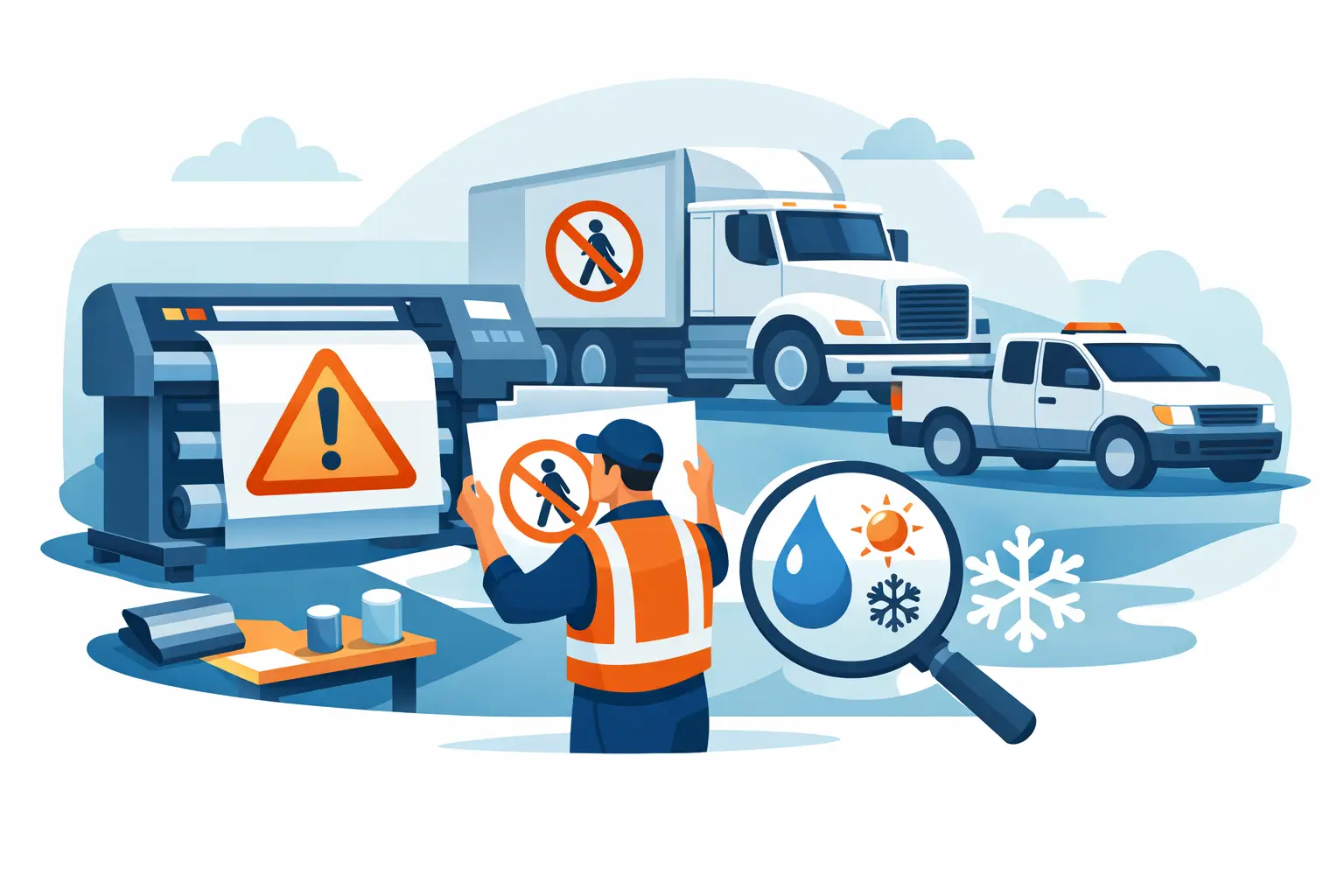
A faded yard sign and a peeling safety decal send the same message to drivers and staff: nobody is paying close attention. In fleet operations, that is a problem. Fleet safety sign printing is not just about putting warnings on a wall or a gate. It is about making directions clear, reducing confusion in busy service areas, and keeping your operation consistent across every vehicle, bay, lot, and customer-facing space.
For fleet managers, service departments, dealerships, and repair facilities, printed safety signage does real work. It tells drivers where to stop, where to check in, where pedestrians cross, what PPE is required, and which areas are restricted. When signs are easy to read and built for daily use, they support safer movement and smoother operations. When they are poorly printed, inconsistent, or placed as an afterthought, they create friction.
What fleet safety sign printing needs to do
Good fleet safety sign printing starts with function. A sign has to be readable at the right distance, hold up in the environment where it is installed, and deliver the message quickly. In a working yard or shop, nobody has time to decode a cluttered layout or small text. Drivers need to recognize the message immediately, especially in areas with vehicle movement, loading activity, or customer traffic.
That means material choice matters just as much as wording. Indoor signs can often use lighter substrates, while outdoor signs need weather resistance, color stability, and enough rigidity to stay presentable over time. Temporary signs have a place, but many fleet environments need products that can handle repeated exposure to sun, moisture, dirt, and routine cleaning.
Consistency matters too. If one site uses red warning signs, another uses handwritten notices, and a third uses faded generic boards, the operation looks disorganized. More importantly, people stop trusting the signage. A consistent print program helps staff and drivers recognize instructions faster because the format stays familiar.
Where fleet safety sign printing makes the biggest impact
The most effective safety signs usually cover routine points of risk and routine points of decision. Entrance and exit signs help control flow before a problem starts. Speed limit signs, stop signs, and directional markers reduce uncertainty in yards with constant movement. Pedestrian crossing signs and restricted access notices help separate foot traffic from active vehicle zones.
Inside the service environment, fleet safety sign printing is often used to mark bay rules, equipment hazards, eye protection requirements, lift safety reminders, and emergency information. These signs are not decorative. They support how the space runs every day. In customer-facing areas, signs can also guide waiting customers, delivery drivers, and after-hours drop-off traffic without requiring staff intervention.
For businesses with multiple vehicles or multiple locations, printed signs also help standardize communication. That matters when different crews, drivers, or service teams rotate through the same property. If the signs are clear and repeatable, training becomes easier and site navigation improves.
Choosing the right material for the job
One of the most common mistakes in fleet safety sign printing is choosing a material based on price alone. Low-cost signs can make sense for short-term use, but they are rarely the best value if they need to be replaced quickly. A sign posted near wash bays, loading areas, or exterior fencing has different demands than one mounted in an office hallway.
Rigid signs are usually the right choice for longer-term outdoor placement because they maintain shape and visibility. Adhesive decals and labels work better when the message needs to be applied directly to doors, windows, equipment, or smooth surfaces within the operation. Magnets can be useful in some situations where temporary placement matters, but only when the surface and use case support secure attachment.
Print quality also plays a bigger role than many buyers expect. High contrast, solid color, and crisp type are what make a sign readable at a glance. If the print is muddy or the colors are weak, the message loses impact. In practical terms, durable materials and high quality prints reduce the number of signs you need to reorder and the amount of time staff spend working around worn-out signage.
Design choices that improve safety, not just appearance
A good-looking sign is not always a useful sign. In fleet settings, layout should support quick recognition. Short wording usually works better than long sentences. Large text, strong contrast, and simple icon use are more effective than trying to fit every detail onto one panel.
This is where many operations benefit from custom printing instead of relying only on generic stock signs. Standard warnings are useful, but custom signs let you match your actual workflow. You can include company identification, site-specific instructions, lot numbering, directional arrows, or internal language that your team already uses. That makes the sign easier to follow because it reflects the environment people are standing in.
There is a trade-off, of course. Generic signs are faster to standardize and may work well for broad warnings like stop, caution, or authorized personnel only. Custom signs take a little more planning, but they often solve the real communication problem better. For many fleet operators, the best setup is a mix of both.
Why fast turnaround matters in fleet safety sign printing
Safety signage is often ordered when something changes. A new traffic pattern is introduced. A bay is reassigned. A customer entrance moves. A compliance issue needs to be corrected. In those moments, turnaround time is not a small detail. It directly affects how quickly you can put a clearer system in place.
That is why experienced buyers tend to work with print suppliers that understand operational deadlines. Quick production is not just a convenience for trade businesses. It helps prevent gaps in communication. If you are opening a new area, updating a service lane, or replacing damaged signs after weather exposure, waiting too long can disrupt the site.
It also helps to work with a supplier that understands repeat ordering. Many fleet and automotive businesses do not need one sign once. They need the same sign again next quarter, or across another location, or in a slightly revised size. Reliable production makes that easier. StickerPlanet Canada is built around that kind of repeat-use print buying, which is why practical businesses tend to value speed and consistency over flashy extras.
Fleet safety sign printing for automotive service businesses
Automotive businesses have a particular set of safety communication needs because service areas combine customer movement, vehicle movement, tools, fluids, and time pressure. A tire shop may need clear signs for re-torque return procedures, loading areas, waiting zones, and no-entry points. A dealership service department may need lane markers, after-hours instructions, walk path signs, and reminders for restricted shop access.
In these environments, the best signage does two jobs at once. It supports safety and improves workflow. A sign that directs customers to the correct drop-off point reduces confusion at the counter. A sign that marks technician-only space helps limit unnecessary traffic in work zones. A sign that clearly identifies parking or pickup areas helps move vehicles in and out faster.
That is one reason product quality matters so much in this category. Shops do not need signs that look acceptable for a week. They need signs that keep doing their job in a busy, hands-on environment.
What to look for in a print supplier
If you are buying fleet safety sign printing, the lowest quoted price should not be the only filter. A dependable supplier should offer durable materials, clear print quality, practical sizing options, and production speed that matches how businesses actually operate. Just as important, they should understand that you are buying signs to solve an operational problem, not to decorate a space.
It also helps when the supplier has experience with service businesses and recurring order patterns. That usually means fewer mistakes, better recommendations on substrates and application, and easier reordering when you need matching signs later. For multi-location businesses, that consistency becomes even more valuable.
The right print partner helps you stay organized. The wrong one leaves you replacing signs too often, managing inconsistent layouts, or settling for products that do not hold up in the field.
Build a system, not just a sign order
The strongest results come from treating signage as part of your operating system. Start with the places where people hesitate, enter the wrong area, miss an instruction, or create avoidable risk. Then match the sign type, size, and material to that exact use. Once the basic system is in place, it becomes much easier to add signs without creating clutter.
Fleet safety sign printing works best when it is deliberate. Clear messages, durable materials, and repeatable design standards make your site easier to navigate and safer to work in. If a sign is worth posting, it is worth printing properly. That small decision tends to pay back every day it stays readable.