
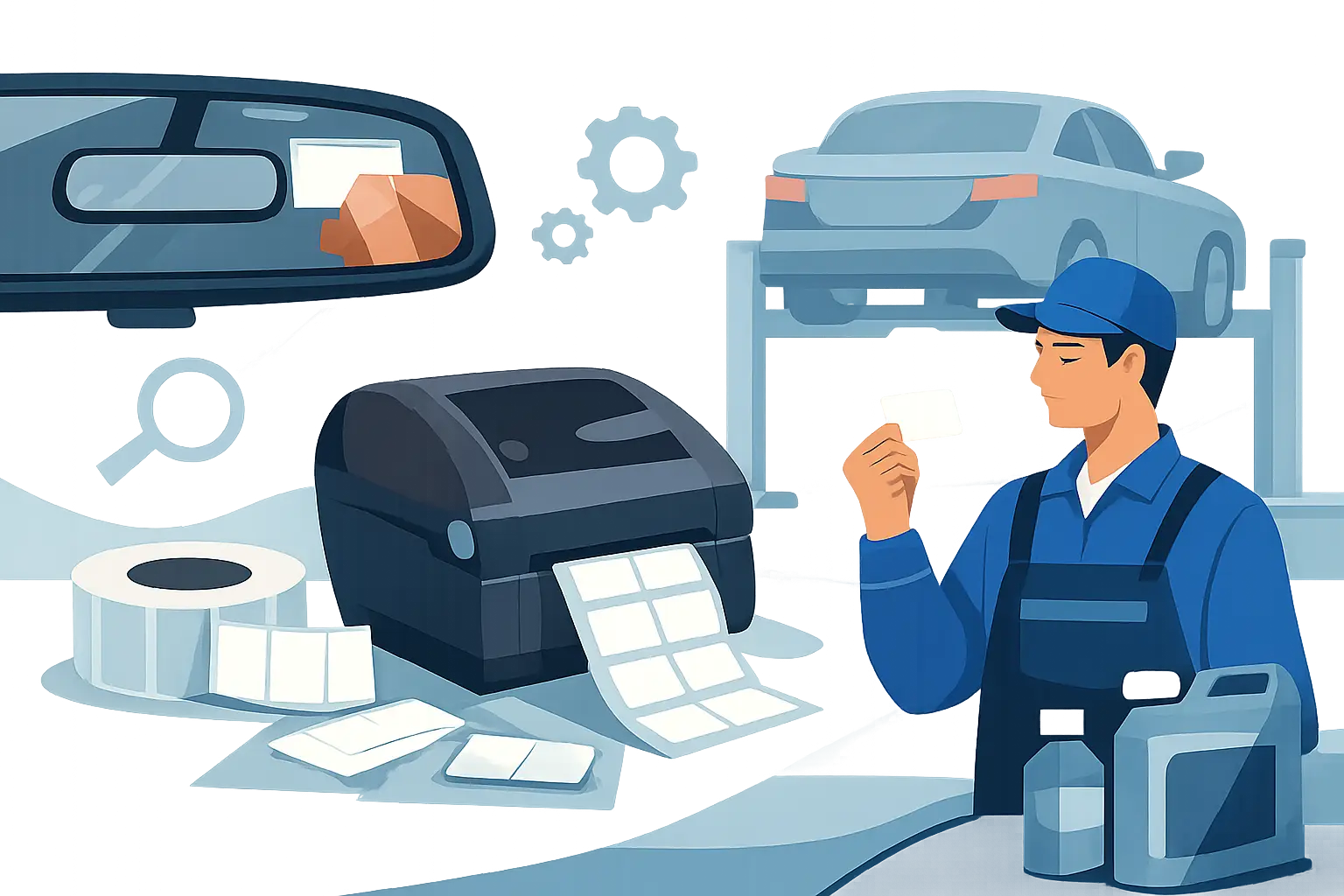
When a service sticker fails, it usually does it in the most expensive way possible. The print fades, the adhesive lifts, the writing smears, or the customer never notices it in the first place. That is why a proper service sticker printing review matters for shops, dealerships, and service departments that rely on reminders to bring customers back at the right interval.
This is not about novelty stickers or decorative labels. Service reminder products are working tools. They carry mileage, dates, service details, shop branding, and next-visit prompts. If they are hard to write on, hard to read, or unreliable on glass, they stop doing the job. A good review has to focus on performance in actual shop conditions, not just whether the colors look sharp on a sample sheet.
What a service sticker printing review should actually measure
The first thing to look at is usability. A service sticker may print beautifully, but if your advisor cannot fill it out quickly during a busy service lane, it creates friction. The layout has to make sense. There should be enough space for mileage, date, and next service information without crowding the sticker. Fonts need to be clear. Boxes and lines should guide fast handwriting, not slow it down.
Material quality comes next. For most automotive service applications, the sticker needs to hold on glass without curling at the corners or leaving a mess when removed. That sounds simple, but adhesive balance is where many cheap products miss the mark. Too weak, and the label peels early. Too aggressive, and customers are left scraping residue off the windshield. The right stock is built for repeat service cycles.
Print consistency matters more than many buyers expect. If one batch prints dark and the next batch looks washed out, your brand starts to look uneven. For multi-location businesses or shops that reorder often, consistency is a practical issue, not a cosmetic one. The same goes for die cutting and sizing. If the format changes from order to order, your staff notices immediately.
Material and adhesive quality make or break the result
In any honest service sticker printing review, adhesive performance deserves close attention. Windshield reminder stickers deal with temperature swings, direct sunlight, cleaning products, and constant visibility. A low-grade adhesive may look fine on day one and fail after a few hot afternoons. That is why shops should ask how the sticker stock is intended to perform in real service environments, not just how it looks fresh off the press.
The face stock also affects daily use. Some materials accept pen or marker better than others. If the surface smudges easily or resists handwriting, the sticker becomes harder to use at the counter or in the bay. That may not show up in a product photo, but it shows up quickly in shop operations. Smooth writing and legible notes are basic requirements.
Durability should also match the service interval. An oil change reminder has different expectations than a temporary lot label, but both need to remain readable for the intended period. If the sticker starts fading before the customer returns, it is no longer doing retention work for your business.
Print quality is more than color
Many buyers think print quality starts and ends with whether the logo looks crisp. That is part of it, but for service labels, functional printing is just as important. Fine text should remain sharp. Service fields should be easy to read from the driver seat. Light backgrounds with dark text usually perform best because they support readability first.
This is also where layout discipline matters. Overdesigned stickers can work against the shop. If too much branding, shading, or decorative detail competes with the service information, the reminder loses its value. The best printed service stickers keep the main message obvious. The customer should see what was done and when to come back without effort.
For custom orders, color matching and logo clarity matter most when the sticker doubles as a small brand impression. A dealership or established repair business should expect consistent reproduction across reorder cycles. If custom branding is offered, it should be handled with the same reliability as stock formats.
Turnaround and reorder reliability matter in real shop use
A shop rarely runs out of service reminder stickers at a convenient time. That is why speed matters in any service sticker printing review. Good pricing does not help much if production drags and the service lane has to improvise. Shops need a supplier that treats these products like operational essentials, not low-priority side work.
Fast production is valuable, but dependable production is even better. A supplier should be able to handle repeat orders without forcing the customer to restart the process every time. Reordering should be simple. Previous specifications should be easy to match. If your service department finds a format that works, the next order should arrive looking the same.
This is one area where specialized print suppliers usually outperform general online printers. A company that regularly produces oil change stickers, tire service reminders, PDI labels, and maintenance labels understands why these details affect daily workflow. That practical understanding often saves the buyer more trouble than a slightly lower unit price ever could.
Service sticker printing review by use case
Not every shop needs the same sticker setup. An oil change center may prioritize fast handwriting, strong windshield adhesion, and high-volume pricing. A dealership may care more about branded presentation and consistency across multiple service categories. A tire shop may need reminder labels tied to re-torque checks, tire rotation timing, or storage identification.
That is why a useful service sticker printing review should judge the product by the job it is meant to do. A generic label can work for some businesses, especially if speed and budget are the main concerns. Custom printed service stickers make more sense when branding, retention, and repeat visibility are part of the strategy.
There is also a trade-off between stock simplicity and custom flexibility. Stock formats are often quicker to order and easier to standardize. Custom formats allow for stronger brand presence and more exact information fields. Neither option is automatically better. It depends on how your service team works and what your customers need to see.
What buyers should watch for before ordering
Price still matters, but it should be judged against performance. The cheapest sticker often becomes expensive if it causes rewrites, early peeling, poor readability, or customer complaints. The better question is whether the sticker supports fast service, clean presentation, and repeat business.
Buyers should pay attention to proofing and setup as well. If a custom sticker is being printed, the layout should reflect actual use. Field spacing, font size, and logo placement all affect whether the sticker works in a live service environment. A print partner that understands automotive reminder products will usually catch issues before they become costly.
Minimum order quantities are another practical factor. Some larger service operations want bulk pricing and stable inventory. Smaller shops may need manageable runs that do not tie up cash or storage space. Good suppliers make room for both without making the ordering process difficult.
For businesses buying across Canada or the United States, local production can also matter when lead times are tight and consistency matters over time. StickerPlanet Canada, for example, is built around practical reminder products for automotive operations, which is exactly the kind of specialization many shops need when reorders are routine rather than occasional.
Final verdict on service sticker value
A strong service sticker is a small product with a very direct job. It keeps your next appointment visible, supports a more professional handoff, and puts your shop name in front of the customer long after the vehicle leaves. That only works when printing, materials, adhesive, and layout all hold up under real use.
If you are comparing suppliers, do not just ask how the sticker looks. Ask how it writes, how it sticks, how it removes, how quickly it can be reordered, and whether the format actually helps your staff move faster. The right service sticker should feel like part of your process, not another item your team has to work around.
A dependable reminder sticker does not need to be flashy. It needs to show up, hold on, stay clear, and help bring the customer back.