
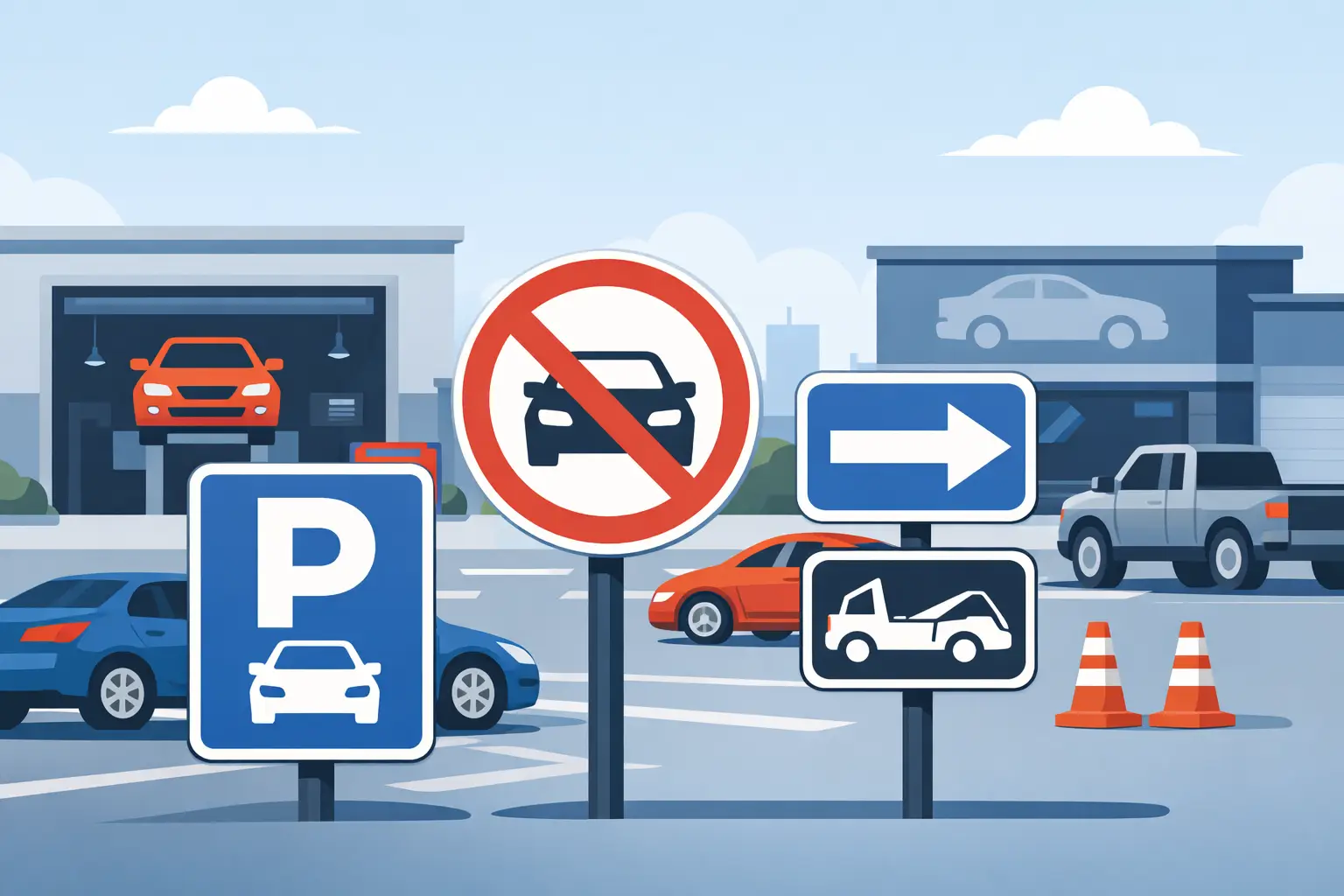
A full lot should mean more business, not more confusion. When customers, tow trucks, parts deliveries, and finished vehicles all compete for space, the best parking signs for auto shops give everyone clear direction before a service advisor has to step outside and sort it out.
For a working shop, parking signs are operational tools. They protect service bays, keep customer entrances clear, reduce the chance of vehicles being blocked in, and present a more organized business from the first visit. The right sign depends on your lot layout, the volume of traffic, local parking rules, and how many different vehicle stages your team needs to manage each day.
What the Best Parking Signs for Auto Shops Must Do
A parking sign should answer a question quickly: Where should I park? Can I leave my vehicle here? Who is this space for? Is this lane open? If the wording is vague, too small, or hidden by parked vehicles, the sign is not doing its job.
For most repair shops, tire centers, oil change locations, detailing businesses, and dealerships, good parking signage needs to do three things. It must be readable from a vehicle, durable enough for outdoor exposure, and specific enough to prevent employees and customers from making assumptions. A generic “Parking Only” sign rarely solves a real shop problem. A sign that says “Customer Drop-Off Only – Please Leave Keys at Service Desk” does.
Material matters as much as wording. Outdoor parking signs need high-quality printing on a rigid, weather-resistant substrate that can handle rain, sun, road salt, and routine lot activity. A faded sign can make a professional operation look neglected, while a damaged sign may create uncertainty around enforcement. Choosing durable materials from the start reduces replacement costs and keeps instructions visible year-round.
Signs for Customer Parking and Drop-Off Areas
Customer parking is often the first source of friction. Visitors may park in a service lane, pull in front of an overhead door, or leave a vehicle in a spot needed for a scheduled appointment. Clear, dedicated signs turn an unmarked area into a usable process.
Use “Customer Parking Only” signs when you have spaces that should remain available for people checking in, waiting for a vehicle, or picking one up. If the spaces are close to the front door, add directional language such as “Customer Parking – Service Entrance.” This is especially useful in multi-tenant buildings or larger facilities where customers may not immediately know which door to use.
A separate drop-off sign is one of the most practical additions for busy shops. It can direct customers to a specific lane or short-term space and tell them what to do next. For example, “Vehicle Drop-Off – Park Here and See Service Advisor” gives a complete instruction without requiring extra conversation. After-hours drop-off areas should be even more direct, with instructions for key envelopes, secure key boxes, and any restrictions on overnight parking.
Reserved Signs That Protect Productive Space
Not every space in an auto shop lot is equal. Some are needed for loaner vehicles, fleet accounts, delivery trucks, employee parking, or vehicles waiting for parts. Without reserved signs, the most convenient spaces tend to be claimed first, regardless of what the operation needs.
“Service Advisor Parking” signs keep the front counter team close to the building without consuming customer spaces. “Employee Parking” signs are useful when staff vehicles regularly spill into customer areas. If employee parking is not obvious, use arrows or a separate directional sign to guide staff to the correct section of the lot.
Reserved customer signs are particularly valuable for businesses that serve commercial accounts, fleet clients, or scheduled express-service customers. A labeled space signals that the shop is prepared for their arrival, but it only works if the space is protected from general parking. Keep the message simple: “Reserved for Fleet Service” or “Appointment Check-In Only.” Avoid using too many reserved categories in a small lot, since excessive restrictions can create more confusion than they solve.
Service Lane, Tow-In, and Delivery Signs
A service lane is revenue-producing space. It should not become overflow parking. Signs such as “Keep Clear – Service Lane,” “No Parking – Active Drive Lane,” and “Tow-In Vehicles Only” help prevent avoidable delays and reduce the risk of blocked vehicle movement.
Tow-in signage deserves careful planning. Tow operators may arrive after hours, may not know your preferred receiving area, and may have limited room to maneuver. A visible “Tow-In Drop-Off” sign with an arrow can keep disabled vehicles from being left in front of bays, customer entrances, or fire routes. If a vehicle needs to be placed in a specific area after hours, state that clearly on the sign and make sure the path is accessible.
Parts deliveries also need a defined place. A “Parts Delivery Only” or “Receiving Area – Keep Clear” sign can prevent a courier from stopping across an active lane. This becomes more important during peak tire seasons, when deliveries, customer vehicles, and technician movement all increase at once.
No Parking and Fire Lane Signs
No-parking signs are not the exciting part of a parking program, but they often do the most work. Use them at garage doors, emergency exits, dumpster access points, drive-through lanes, loading areas, and anywhere a parked vehicle creates a safety or workflow problem.
The wording should match the reason for the restriction. “No Parking – Keep Garage Door Clear” is more useful than a generic no-parking notice because it tells drivers why the space cannot be used. Likewise, “Fire Lane – No Parking” should be placed where emergency access must remain open. Local requirements may govern wording, color, mounting height, and enforcement language for fire lanes and accessible parking, so confirm the rules that apply to your property before ordering those signs.
Do not treat accessibility signs as ordinary reserved parking signs. Designated accessible spaces, access aisles, and related markings must meet applicable legal requirements. If your lot is being renovated or restriped, coordinate signage with the local code and the property owner where appropriate.
Directional Signs Reduce Questions at the Counter
Directional signs are especially effective when your building layout is not obvious from the street. Customers should be able to find the service entrance, waiting area, tire department, vehicle pickup location, and exit without driving around the lot or walking through work areas.
Arrows do most of the work. A sign reading “Service Check-In ->” is faster to understand than a paragraph of instructions. Place it early enough that a driver can safely choose the correct path. If the sign appears only after the turn has been missed, it is too late.
For larger operations, use a consistent sign system. Match colors, type style, and message structure across customer parking, drop-off, pickup, and employee areas. Consistency makes signs easier to scan and strengthens the organized, professional impression customers take from the visit.
Choosing the Right Size, Mounting, and Message
A sign’s location determines its size. A sign viewed from a few parking spaces away can be smaller than one meant to direct vehicles entering from the street. Before ordering, stand where the driver will be when they need the instruction. Consider windshield glare, nighttime visibility, parked trucks, snowbanks, landscaping, and whether the sign will be read while moving.
Post-mounted signs work well for parking spaces and lot entrances. Wall-mounted signs are practical near service doors, key drop areas, and receiving zones. If a message needs to be visible from more than one approach, consider placement on both sides of a lane or use separate signs for entering and exiting traffic.
Keep messages short. The strongest signs usually combine a clear category, a simple restriction or instruction, and an arrow when needed. Long policies belong at the service counter or in customer communications, not on a sign that must be read through a windshield.
Custom signs are worth considering when stock wording does not match your workflow. Adding your business name, a department label, a phone number for after-hours arrivals, or a specific instruction can eliminate repeated questions. StickerPlanet Canada produces practical parking signs and related printed materials for businesses that need clear, repeatable communication in high-traffic environments.
Build the Lot Around the Customer Journey
Walk your property as if you were arriving for the first time with a vehicle that needs service. Where do you enter? Where do you stop? Which door do you use? Where do you leave keys after hours? Then repeat the walk from the perspective of a tow operator, parts driver, and technician.
The gaps become obvious quickly. Maybe customers need a sign before the driveway split. Maybe finished vehicles need a marked pickup area so they do not crowd the drop-off lane. Maybe employees need better directions to keep front spaces open. The best sign program is not the one with the most signs. It is the one that removes the daily questions, blocked lanes, and parking mistakes that slow your shop down.