
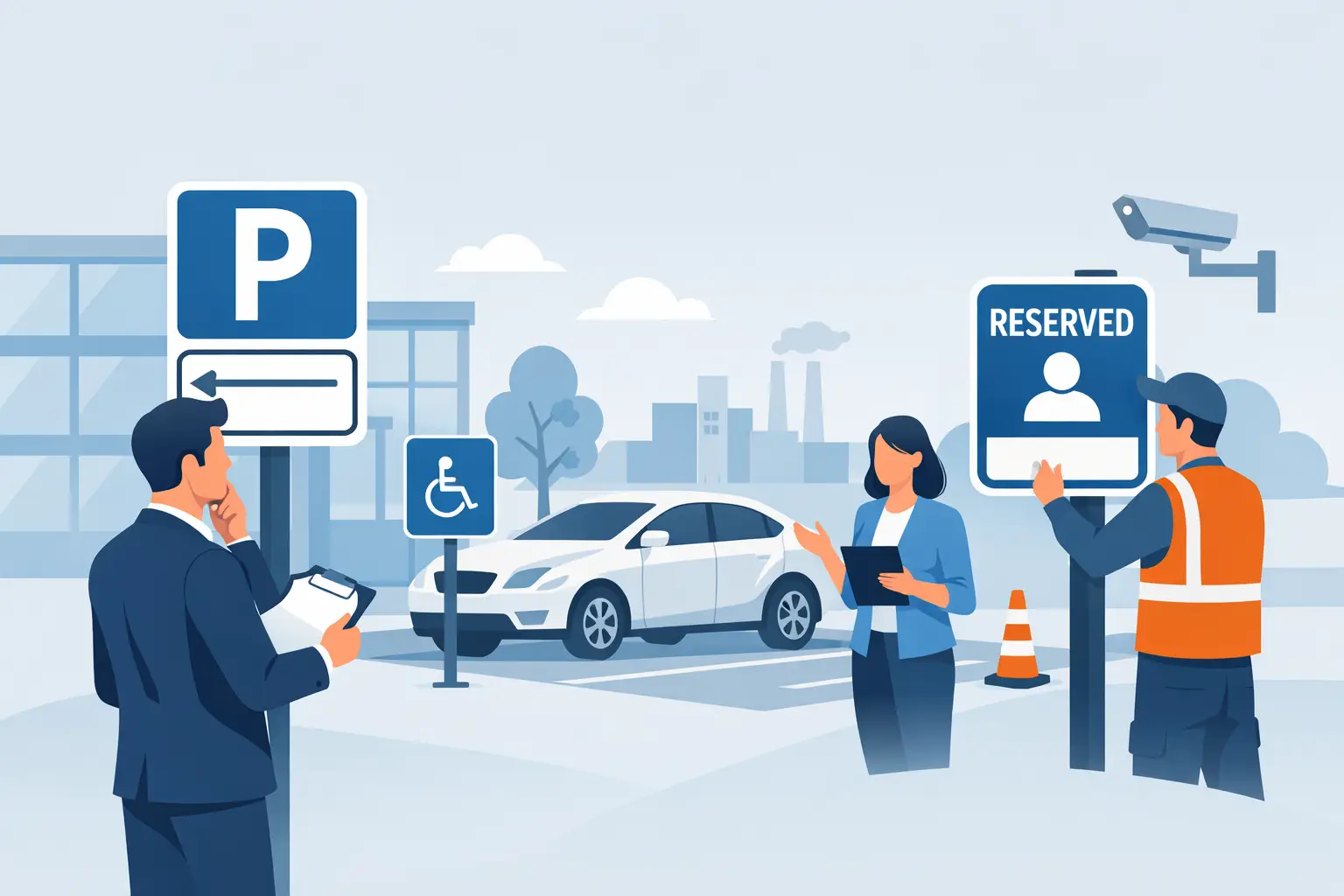
A parking lot starts communicating before a customer reaches the service counter. A faded reserved sign, unclear visitor spaces, or a blocked service entrance can create avoidable confusion during a busy day. This custom parking signs review looks at what makes a sign effective for repair shops, dealerships, tire stores, detailing operations, and other working businesses that need their property to stay organized.
The best parking sign is not necessarily the biggest or the most expensive. It is the one drivers can understand quickly, employees can rely on every day, and your business can replace or reorder without a long delay. Material, message, visibility, and installation all matter.
What a Custom Parking Sign Should Accomplish
Parking signs are operational tools. They direct customers to the right entrance, protect staff and reserved spaces, separate vehicle storage from customer parking, and help keep delivery routes or fire access areas clear. For automotive businesses, they can also identify quick-lube lanes, service-write-up parking, tire storage areas, shuttle pickup zones, or vehicles awaiting pickup.
A custom sign earns its place when it answers a question without requiring an employee to step outside. Where should I park? Is this space reserved? Can I leave my vehicle here? Which door do I use? Clear signs reduce those interruptions and help the lot feel orderly even when the shop is at capacity.
Customization is especially useful when standard wording is too broad. “Customer Parking Only” is useful, but “Service Check-In Parking – Please Leave Keys at Front Desk” gives drivers a much clearer next step. Adding your business name, logo, phone number, or a location-specific instruction makes the sign work harder for your operation.
Custom Parking Signs Review: Materials That Hold Up
The material decision should be based on where the sign will be used, how long it needs to last, and how much physical abuse the area receives. An indoor parking-garage notice and an exterior lot sign do not need the same construction.
Aluminum for long-term outdoor use
Aluminum is the practical choice for permanent exterior parking signs. It resists rust, handles changing weather, and stays relatively light for post mounting. For lots exposed to snow, rain, sun, road salt, and frequent temperature changes, a quality aluminum sign is generally worth the added upfront cost.
Look for cleanly finished edges, pre-drilled mounting holes when needed, and print designed for outdoor exposure. A sign may have the right message, but it will not help much if the colors fade quickly or the corners bend after a season.
Plastic and coroplast for temporary needs
Corrugated plastic, often called coroplast, works well for short-term directions, construction-related parking changes, special events, or temporary overflow parking. It is lightweight and affordable, but it is not intended to take the same long-term punishment as aluminum.
Plastic sign materials can also make sense indoors or in sheltered areas. The trade-off is durability. If vehicles, carts, wind, or snow-clearing equipment routinely come near the sign, a stronger material usually prevents repeat replacement costs.
Reflective finishes for low-light visibility
Reflective material is worth considering for signs read after dark, especially near entrances, service lanes, or areas with limited lighting. Headlights can make a reflective sign easier to see, which is useful for after-hours drop-off instructions and restricted parking notices.
Not every sign needs reflectivity. A sign mounted inside a brightly lit customer reception area does not require it. But for an exterior lot that stays active early in the morning or late at night, it can improve visibility without making the layout more complicated.
Message and Layout Matter More Than Extra Design
A parking sign has only a few seconds to do its job. Too much copy, small type, and busy graphics slow the reader down. The strongest designs lead with the action or restriction, then provide only the supporting information needed to follow it.
For example, “Reserved for Service Customers” should be the dominant message. If towing information, office hours, or a phone number is required, it belongs underneath in smaller type. Do not let the fine print compete with the instruction drivers need first.
High-contrast color combinations are usually the safest choice. Dark lettering on a light background or light lettering on a dark background is easier to read from a distance than low-contrast brand colors. Your logo can still be included, but legibility should come first. A parking sign is not a brochure.
Use plain language wherever possible. “No Customer Parking Beyond This Point” is clearer than a long policy statement. Directional arrows should be large, unambiguous, and pointed in the correct direction. Before approving artwork, imagine a first-time customer trying to read the sign from a vehicle while another car waits behind them.
Choosing the Right Size and Mounting Method
Sign size depends on viewing distance and vehicle speed. A small sign can work on a door, gate, or close-range wall. A sign intended to guide drivers across a lot needs larger lettering and more visual space. When in doubt, choose a size that can be read comfortably before the driver reaches the decision point.
Mounting also affects performance. Post-mounted signs are best for open lots and reserved spaces. Wall-mounted signs work well near service doors, customer entrances, and loading areas. Fence-mounted signs can help define boundaries, but they need secure fastening so wind and vibration do not cause damage over time.
Placement is just as important as the sign itself. Put the instruction before the driver needs to act, not after. A “Service Parking” sign located beyond the turn into the service lane is too late. Use a sequence when the route is not obvious: one sign at the entrance, a second at the turn, and a final sign at the destination.
Make sure signs are not blocked by parked trucks, landscaping, snow piles, open gates, or seasonal displays. A quick walk-through from the driver’s perspective can reveal issues that are easy to miss from the office window.
When Standard Signs Are Enough and When Custom Is Better
Standard signs are a good fit for universal messages such as handicap parking, stop, no parking, or fire lane notices, provided they meet the requirements that apply to your property. They are fast to buy and familiar to drivers.
Custom parking signs are better when your lot has specific workflow needs. A dealership may need designated areas for sold-vehicle delivery, overnight drop-off, loaner return, and service advisor parking. An independent garage may need to protect bays from customer parking or direct vehicles to a key-drop box after hours. A tire shop may need clear separation between customer spaces and inventory staging.
There is also a legal distinction to keep in mind. A custom sign can communicate your business policy, but it does not automatically create legal enforcement authority. Requirements for accessible parking, fire lanes, towing notices, and reserved spaces can vary by municipality, province, state, and property type. Confirm local rules before ordering signs that reference penalties, towing, or regulated parking designations.
Ordering Details That Prevent Costly Reprints
Before placing an order, confirm the exact wording, sign size, quantity, material, finish, and mounting-hole location. It helps to identify where each sign will go and measure the available mounting area first. That avoids ordering a sign that is too wide for a post, too small for the viewing distance, or drilled in a way that does not match existing hardware.
Proofing deserves a careful review. Check phone numbers, arrows, business hours, spelling, and any reference to specific customer instructions. Ask someone who was not involved in writing the sign to read it. If they hesitate over what it means, simplify the message before it goes to print.
For repeat-use operations, keep the approved artwork and specifications on file. That makes future reorders consistent when a sign is damaged, a new location opens, or the parking layout changes. StickerPlanet Canada can support businesses that need practical custom signage with clear print specifications and dependable production for ongoing operational needs.
A well-made parking sign will not solve every lot problem, but it can eliminate a surprising number of small daily delays. Start with the point where customers most often hesitate, then install a clear instruction where they can see it in time to act.