
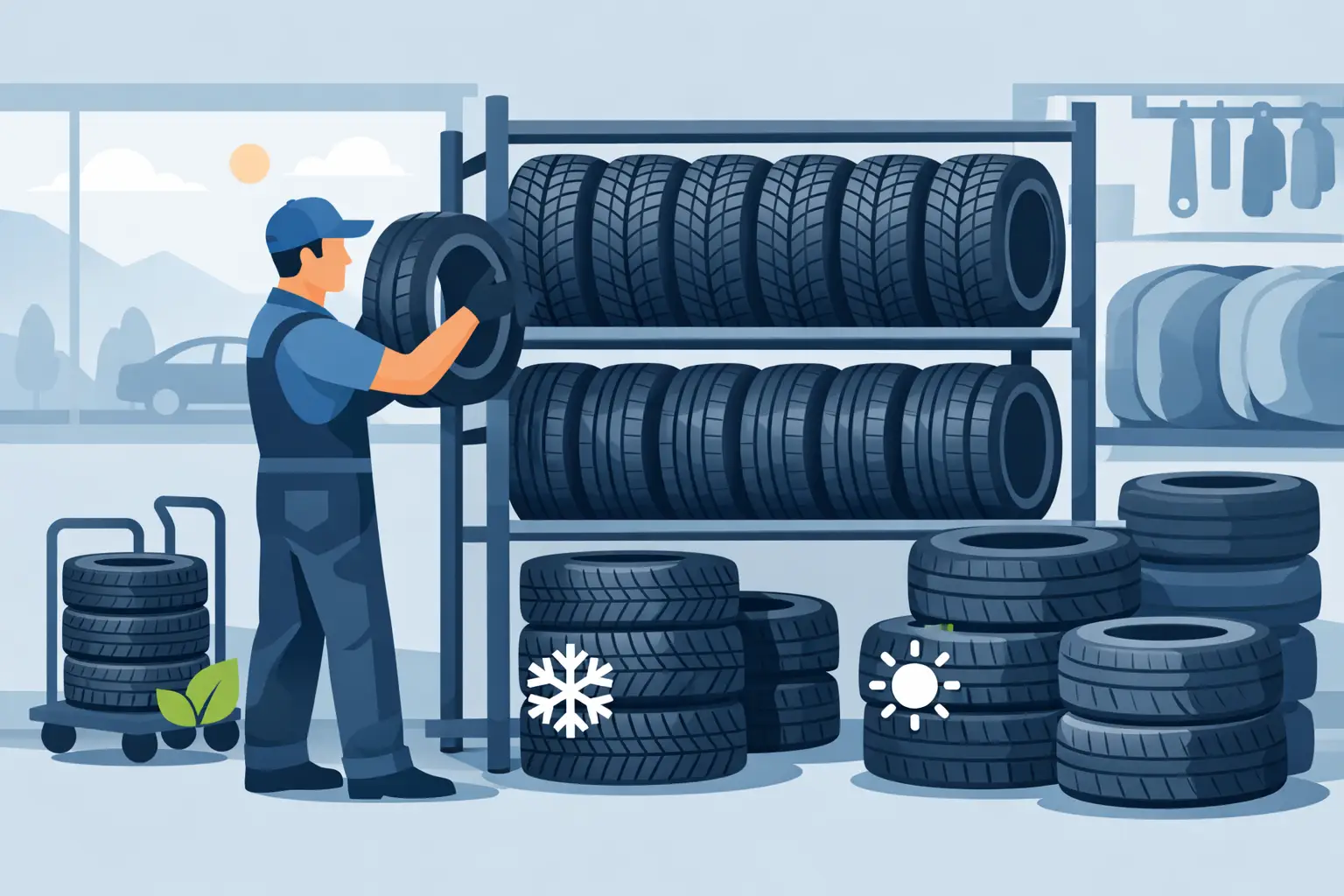
The first cold snap or spring rush tells you very quickly whether your tire storage system works. Shops that handle seasonal changeovers at volume cannot afford guesswork, misplaced sets, or handwritten notes that only one advisor can decode. That is exactly why how auto shops organize seasonal tire storage comes down to process more than space. A clean system protects inventory, speeds up retrieval, and keeps the front counter from turning into a bottleneck.
For most shops, tire storage is not just a convenience offered to customers. It is an operational service with real labor, real floor space, and real liability. If the system is loose, the problems show up fast – lost time in the warehouse, mixed-up wheel sets, damage claims, and frustrated customers waiting during peak season. If the system is tight, storage becomes easier to sell, easier to manage, and easier to repeat year after year.
How auto shops organize seasonal tire storage in practice
The best storage setups are built around one idea: every tire set needs a clear identity from the moment it leaves the vehicle. Shops that do this well do not rely on memory or visual recognition. They create a chain of information that starts at removal, stays with the set in storage, and follows it back to the right customer at reinstall time.
That usually starts with assigning each set a storage record tied to the customer account, vehicle details, season, and storage location. Some shops use a shop management system with storage fields. Others use a simpler spreadsheet or inventory platform. The software matters less than consistency. If one employee writes “Ford Escape winters” and another writes “John S. tires,” retrieval gets messy fast.
A strong record usually includes the customer name, phone number, vehicle year, make and model, tire size, whether the tires are mounted on wheels, tread condition, any wheel damage, and the exact shelf or row location. Many shops also record torque or reinstallation notes if they want the next appointment to move faster.
Labeling is where the system either holds or breaks
If there is one part of seasonal storage that deserves more attention, it is labeling. Good labels reduce handling mistakes and shorten search time. Weak labels create delays and force staff to double-check everything manually.
Shops that stay organized tend to use durable tire storage labels or tags that can handle dust, temperature changes, and repeated movement. The label needs to be readable at a glance and should match the digital or written storage record exactly. At minimum, it should identify the customer, vehicle, season, and position in storage. Many shops also add service dates, bay notes, or a stock-style reference number to make pull orders easier.
There is a trade-off here. A very detailed label gives staff more information on the floor, but it can also slow down intake if the process is too complicated. A shorter label is faster to apply, but only works if the software record is accurate and easy to access. The right balance depends on shop volume. High-throughput tire shops usually benefit from standardized printed labels because they cut down on handwriting errors and keep every stored set formatted the same way.
Storage layout matters more than total square footage
A large storage room does not guarantee good organization. In many cases, smaller shops run tighter operations because they are forced to use every aisle and rack position carefully. The key is having a layout that supports fast intake and retrieval during peak season.
Most shops organize storage by zone, row, and shelf level. That gives each tire set a fixed address. Instead of telling staff to find a set “in the back near the winter tires,” they can go straight to B-4-2 or a similar location code. When the location code appears on both the label and the customer record, the pickup process gets much more predictable.
Mounted tire and wheel assemblies are often stored differently than loose tires because of weight, size, and damage risk. Some shops rack complete sets vertically on shelving designed for wheel assemblies, while others stack loose tires by set in assigned rows. Neither method is automatically better. Vertical storage can protect wheels and make identification easier, but it may require more rack investment. Stacked storage uses space efficiently, but only if the sets are clearly tagged and not piled so high that retrieval becomes unsafe or slow.
Shops with heavier seasonal traffic often reserve separate areas for incoming sets, active pickups, and long-term stored inventory. That simple split can save a lot of walking and reshuffling when the rush hits.
Intake needs to be standardized
The most organized shops do not leave tire storage intake to individual habits. They use a repeatable check-in routine every time. Once the tires come off the vehicle, staff inspect them, confirm the customer and vehicle details, record tread depth or wear issues if needed, apply the storage label, and move the set into a designated staging area before final placement.
This step is where damaged wheels, abnormal wear, missing valve caps, or low tread should be documented. That protects the shop later if a customer questions the condition of the tires at reinstallation. It also creates a sales opportunity for replacement recommendations before the next season arrives.
Some shops add colored stickers or seasonal markers to separate winter and summer inventory at a glance. That can help on busy days, but it should support the main tracking system, not replace it. Color coding is useful for visual sorting. It is not enough by itself for accurate inventory control.
Retrieval should be planned before the customer arrives
A common mistake is treating storage retrieval as something that starts when the customer checks in. Organized shops pull stored sets in advance whenever possible. That means confirming the appointment, locating the tires the day before or the morning of service, and moving them into a ready area near the bays.
This is where a storage system proves its value. If the staff can retrieve the set in two minutes instead of twenty, the whole appointment runs smoother. Service advisors can quote more accurately, technicians spend less time waiting, and customers see the storage program as a convenience instead of a delay.
It also helps to build a simple verification step into retrieval. Before the set goes back onto the vehicle, staff should confirm the customer, vehicle, and tire details against the work order. That extra check takes very little time and can prevent one of the most frustrating mistakes a shop can make.
Why printed tools still matter in a digital workflow
Even shops with strong software rely on physical identifiers. Tires move through bays, staging zones, shelves, and sometimes off-site storage. Staff are not always standing at a terminal when they need information. That is why printed labels, storage stickers, and location tags still play such a practical role.
A dependable printed label acts as the bridge between the service counter and the storage area. It gives technicians and lot staff a fast visual reference without forcing them to stop and look up every detail. For shops managing high seasonal volume, that kind of repeatable printed process is not a small detail. It is part of how the operation stays efficient.
This is one reason operations-focused shops invest in purpose-built printed materials rather than generic office labels. Automotive storage environments are hard on paper and adhesive products. If labels smear, peel, or fall off, the storage system weakens quickly.
The shops that do it best think beyond storage
Seasonal tire storage is also a customer retention tool. When a shop stores the customer’s off-season set, it creates a natural reason for that customer to come back for the next changeover. But that only works if the process feels reliable.
A customer who hears, “We need a few extra minutes to find your tires,” may overlook it once. If it happens repeatedly, confidence drops. On the other hand, when the set is ready, the paperwork is clean, and the visit moves on schedule, the storage program starts to feel like part of a professional service operation.
That is why many shops tie storage into their reminder system. Seasonal service reminders, storage identification labels, and re-torque or follow-up stickers help keep the next visit connected to the last one. For a business built on repeat service, those small operational details matter.
StickerPlanet Canada works with automotive businesses that need exactly that kind of practical printed support – products built for repeat use, fast handling, and clear customer communication.
What separates an average system from a strong one
Average storage systems rely on good employees remembering where things went. Strong storage systems assume people are busy and build clarity into the process. They use fixed location codes, durable labels, consistent naming rules, and a standard intake routine. They make it easy for one employee to pick up where another left off.
There is no single perfect setup for every shop. A dealership with a large warehouse will organize storage differently than an independent repair shop using compact racking. The important part is choosing a method that fits your space, staff, and seasonal volume, then sticking to it without exceptions.
If your storage area gets chaotic every spring and fall, the answer is usually not more effort. It is a better system. Put a clear identity on every tire set, give every set a fixed location, and make retrieval part of appointment planning instead of a last-minute scramble. When the process is organized, tire storage stops being a seasonal headache and starts working like the service you intended to sell.