
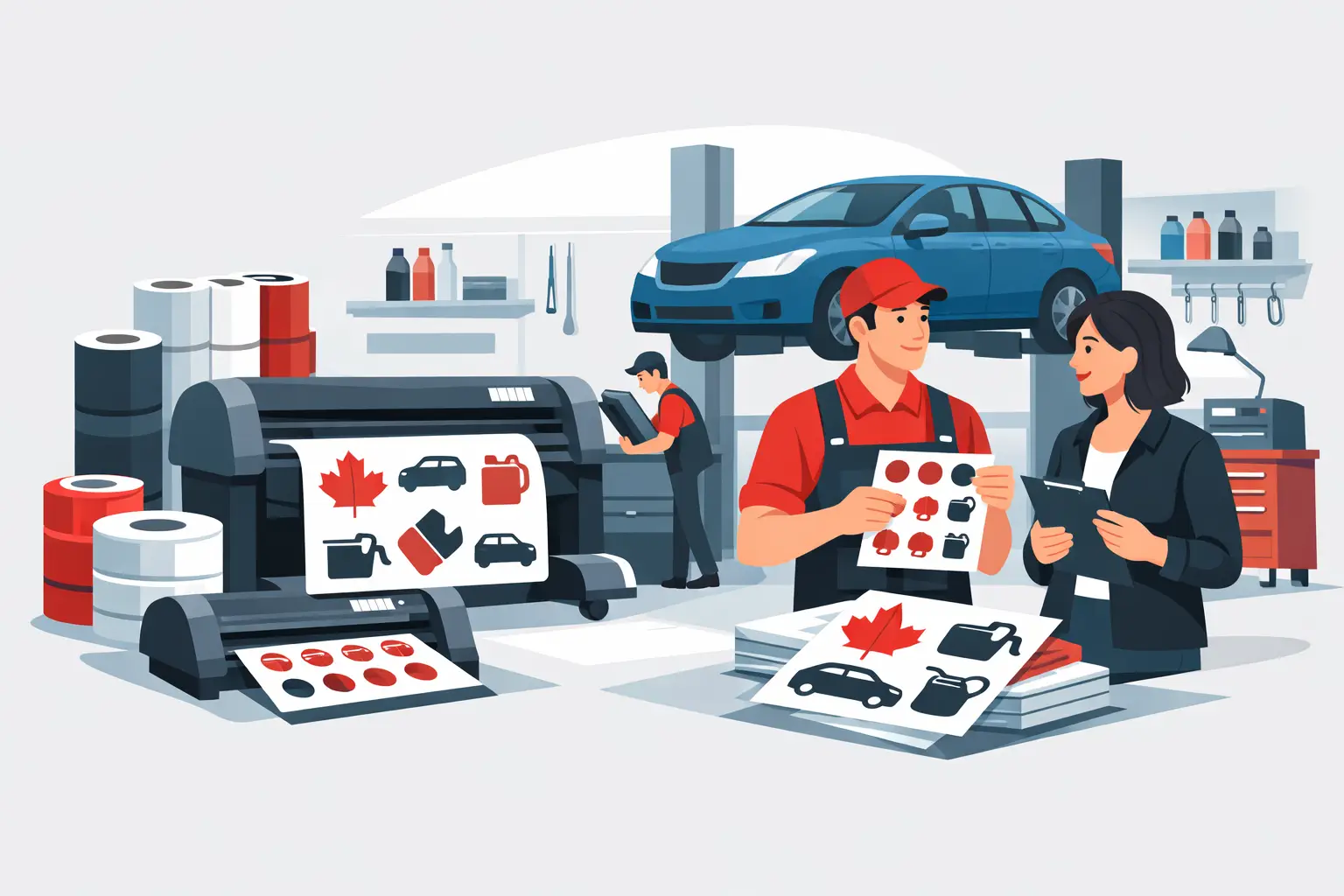
A service reminder only works if customers can read it, trust it, and see it at the right time. That is why Canadian sticker printing for automotive businesses is less about decorative design and more about producing durable, accurate tools that keep your shop top of mind after the vehicle leaves the bay.
For oil change centers, tire shops, repair garages, detailers, and dealership service departments, stickers often carry a simple but valuable message: the next step. A clear oil change interval, tire re-torque date, rotation reminder, or dealer contact line can help turn a completed job into a future appointment.
What Good Canadian Sticker Printing Needs to Deliver
A sticker may be small, but it has a specific job to do. It needs to adhere properly, stay legible through temperature changes and sunlight, and communicate service information without asking the customer to hunt for details. When a shop orders repeat-use reminder products, consistency matters just as much as the initial price.
The right product depends on where it will be used. Windshield service reminders need an adhesive and stock suited to glass. Tire storage labels need enough writing space to identify the customer, vehicle, and tire location. Maintenance-light stickers need clean, high-contrast print that remains easy to read in a service lane or vehicle interior.
Generic stickers can work well when the message does not change. Custom stickers make more sense when your business needs its own logo, phone number, address, service intervals, or branding. Neither option is automatically better. The practical choice is the one that helps your team complete the job quickly and gives customers a clear reason to return.
Start With the Service Problem You Need to Solve
Before choosing a size, shape, or finish, look at the point in your process where communication tends to break down. A reminder sticker should reduce a real operational problem, not add another item for staff to manage.
For example, an oil change reminder sticker is useful when it gives the next mileage or date and clearly identifies the shop that performed the work. Tire re-torque labels are valuable when they help customers remember a required follow-up after wheel installation. Tire rotation stickers can support a recommended maintenance schedule and give your team a natural reason to reconnect with the vehicle owner.
Dealership identification labels and PDI stickers serve a different role. They can keep internal vehicle handling organized, confirm completed steps, or make dealer information easy to find. Detailers may use maintenance reminder stickers to encourage recurring care. The common thread is simple: each label should make the next action obvious.
Avoid trying to place every service, promotion, policy, and social media handle on a small sticker. The more crowded the layout becomes, the less likely a customer is to notice the important information. Give the primary message room to work.
Build the Layout Around Readability
For most automotive reminder stickers, the essentials are the service type, next due date or mileage, and a direct way to reach the business. Your logo can reinforce recognition, but it should not overpower the service details. Customers should be able to understand the reminder in a few seconds.
Use strong contrast between text and background. Dark lettering on a light background is often the most practical option for handwritten fields and service information. If your staff writes in mileage, date, technician initials, or tire positions, leave enough blank space and test the pen type your team uses.
Small type may look sharp on screen but become hard to read from the driver’s seat. A clean layout with larger text is usually more useful than a crowded design with fine details. This is especially true for windshield stickers, where glare, distance, and tinted glass can affect visibility.
Material Choices Matter in Real Shop Conditions
Print quality is only part of the equation. Automotive environments bring heat, cold, moisture, cleaning products, handling, and extended exposure to sunlight. Materials should be selected for the job, not simply because they are the least expensive option.
For interior windshield reminders, the adhesive needs to hold securely while still allowing reasonable removal when the next service is performed. For labels used in tire storage, parts areas, or workflow tracking, durability and readable writing surfaces are often the priority. Signs, magnets, and floor graphics have their own demands based on placement, traffic, and cleaning routines.
A low-cost sticker that curls, fades quickly, or loses adhesion creates more work than it saves. It can also make a professional shop look careless. On the other hand, not every application needs the heaviest-duty material available. Ordering the right stock for the actual use helps control costs without cutting corners where performance matters.
Why Fast, Consistent Production Helps Operations
Shops do not order reminder stickers once and forget about them. These are repeat-use supplies. When the oil change reminder pad runs low or the tire season creates a rush for re-torque labels, waiting weeks for a reorder can interrupt a process your team relies on every day.
Quick production matters because it protects consistency. Your advisors and technicians should not have to switch to handwritten paper notes or mixed sticker styles when inventory runs short. Standardized printed materials make service communication look organized across every technician, location, and customer interaction.
Local Canadian manufacturing can also make planning easier for businesses that value dependable turnaround and North American materials. For businesses serving customers in Canada or the United States, the strongest supplier relationship is one built on repeatable print quality, clear ordering options, and products that arrive ready for use.
StickerPlanet Canada focuses on practical print products designed around those repeat operational needs, from service reminder stickers and labels to magnets, signs, and customer-facing materials.
Order Quantities That Match Your Workflow
The lowest unit price often comes with a larger order, but buying more is not always the best business decision. A high-volume oil change center may move through a large quantity of windshield reminders quickly. A smaller repair shop may need fewer stickers, especially if service intervals, phone numbers, or branding could change during the year.
Consider how frequently you use each item, how many service bays you run, and whether the information is likely to change. If your technicians use a particular label every day, ordering enough to avoid interruptions makes sense. If it is a specialized label used only during tire season or for occasional inspections, a smaller run may be more practical.
It also helps to keep a simple reorder point. When inventory reaches a set number of pads, rolls, or sheets, place the next order before your staff starts rationing supplies. This small habit prevents last-minute purchasing and keeps the front counter, service drive, and shop floor working from the same materials.
Check Proofs With the People Who Use Them
A proof should be reviewed by more than the person approving the purchase. Ask a service advisor whether the phone number is clear. Ask a technician whether the write-in fields are large enough. Ask the person applying the sticker whether the size fits the intended location.
This takes only a few minutes and catches expensive mistakes before a full order is printed. It also keeps the design grounded in real use rather than computer-screen assumptions. A reminder product that works well in a busy bay is the one worth reordering.
Turn Every Sticker Into a Better Return Visit
Service reminders are not a replacement for customer follow-up, but they support it. They remain in view between visits and give customers a physical prompt when mileage, season, or time signals that maintenance is due. For many shops, that is a straightforward retention tool already built into the service process.
The most effective sticker is not the one with the most elaborate design. It is the one your team applies consistently, your customer understands immediately, and your shop can replenish without delay. Choose materials and messaging that fit the work you do, then make the sticker part of every completed service. That is how a small printed item keeps earning its place in your daily operation.