Seasonal tire storage creates a practical identification problem. Tires arrive wet, cold, dusty, and often dirty from road use. They are moved between racks, storage areas, tire bags, and service bays. A label that works on a clean office file may not remain attached to a rubber tire tread for an entire storage season.
For Canadian tire shops, dealerships, and garages, the material choice is straightforward: custom tire storage stickers printed on pressure-sensitive self-adhesive vinyl are built for the job; ordinary paper labels are not.
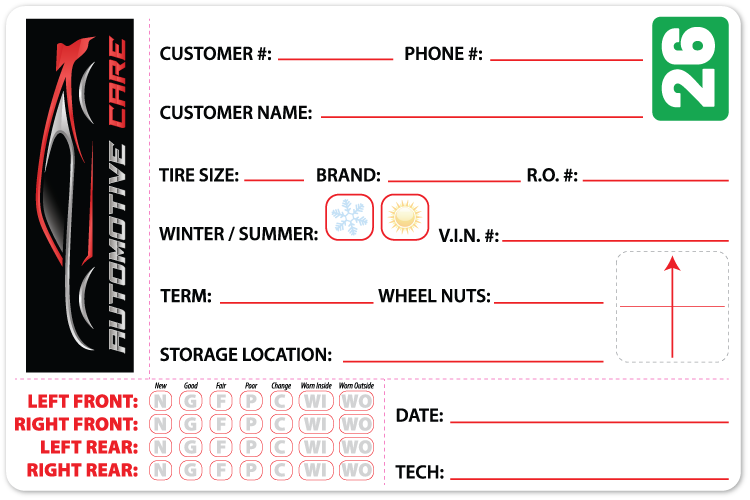
The right label helps your team identify:
- Customer name and number
- Phone number
- Tire size and brand
- Repair order number
- VIN
- Winter or summer set
- Storage location
- Wheel position
- Tread condition
- Date and technician
That information reduces mix-ups and makes seasonal tire changes easier to manage.
Why Paper Labels Fail on Stored Tires
Paper labels are designed primarily for clean, dry, smooth surfaces. Tire treads provide the opposite conditions.
During seasonal handling, paper labels may be exposed to:
- Moisture from rain, snow, washing, or condensation
- Cold storage areas and temperature changes
- Dust, road salt, brake residue, and rubber debris
- Rough, textured tread blocks
- Repeated handling and friction
- Tire bags, shelving, carts, and storage racks
- Grease and other common garage contaminants
A paper label can absorb moisture, soften, tear, or lose its print. Its general-purpose adhesive may also fail to establish a reliable bond on textured rubber. Once a label peels away, the tire set can become difficult to identify.
This is more than an appearance problem. A missing label can lead to:
- Time spent searching through storage racks
- Incorrect tire assignments
- Delayed seasonal installations
- Repeated calls to customers
- Unnecessary reinspection of tire sets
- A less organized customer experience
Paper may seem cheaper at the time of purchase, but a label that does not survive storage is not a cost-saving solution.
Why Vinyl Tire Storage Stickers Perform Better
StickerPlanet.ca produces custom tire storage stickers using pressure-sensitive self-adhesive vinyl. The material is flexible, durable, and suitable for application to rubber surfaces.
The permanent adhesive is selected to provide reliable bonding to tire tread and other difficult surfaces. It is designed to make contact with the textured rubber surface and hold through the storage season rather than lifting at the edges after the tire is moved.
The application process still matters. For best results:
- Remove loose dirt and debris from the application area.
- Avoid placing the sticker across deep grooves or heavily contaminated sections.
- Apply the label firmly and smooth it across the tread.
- Press the edges down to establish full contact.
- Allow the adhesive to bond before excessive handling whenever possible.
The adhesive can support both dry and wet application conditions, but removing standing water and loose contamination gives the label the best opportunity to bond securely.

Vinyl vs. Paper: Material Comparison
| Feature | Custom vinyl tire storage sticker | Ordinary paper label |
|---|---|---|
| Moisture resistance | Weatherproof and waterproof vinyl resists moisture during storage and handling. | Paper can absorb water, soften, wrinkle, or delaminate. |
| Tear resistance | Flexible vinyl resists tearing when tires are moved or handled. | Paper can rip when caught on tread, bags, racks, or equipment. |
| Adhesion | Permanent pressure-sensitive adhesive is designed for rubber and textured tire surfaces. | General-purpose adhesive may not bond properly to dirty, cold, or uneven rubber. |
| Writable surface | Matte, hand-writable surface accepts permanent markers and regular ball-point pens. | Writing may smear or become illegible when the paper gets wet. |
| Seasonal handling | Built to remain readable and attached while tires are stored, moved, and retrieved. | Higher risk of peeling, fading, tearing, or complete label loss. |
| Print durability | Printed with eco-solvent inks for vivid, durable identification. | Ink may run, fade, or become difficult to read after moisture exposure. |
| Shop suitability | Designed for tire storage workflows, customer records, and tread inspection notes. | Designed mainly for clean indoor labeling applications. |
Choose the Correct Sticker Size
StickerPlanet.ca offers three true tire storage sticker sizes. Selecting the correct format helps you balance readability, information capacity, and material cost.
6 x 4 inches: Maximum information
The 6 x 4-inch sticker is the largest standard format. It provides room for complete customer and tire records, including:
- Customer information
- Tire size and brand
- VIN and repair order number
- Storage location
- Wheel nut information
- Winter or summer identification
- Four-position tread condition tracking
- Date and technician details
This is a strong choice for shops that want a full inspection and storage record on every tire.
4 x 3 inches: Compact tread labeling
The 4 x 3-inch sticker is smaller but still provides useful space for the essential identification fields. It is a practical option when the shop needs a clear label on the tread without using the largest format.
The 4 x 3-inch format is also useful when:
- Storage space is limited
- The shop uses a separate digital record
- The label needs to fit a narrower tread area
- Technicians require a compact, readable identification system
The 6 x 4-inch and 4 x 3-inch formats are used for tire treads and represent approximately 99% of StickerPlanet.ca tire storage sticker sales.
3 x 2 inches: Best for tire bags
The 3 x 2-inch sticker is designed primarily for bagged tires. It is suitable for placing identification on a tire bag when the individual tire does not need a large tread label.
Use this size for:
- Bagged tire sets
- Secondary bag identification
- Storage bins or containers
- Shorter identification records
- Workflows where the main customer record is stored digitally

Understand Area-Based Pricing
Sticker pricing is based partly on the amount of material used. The dimensions are important when comparing formats.
- A 6 x 4-inch sticker has an area of 24 square inches.
- A 4 x 3-inch sticker has an area of 12 square inches.
- A 3 x 2-inch sticker has an area of 6 square inches.
Therefore, one 6 x 4-inch sticker uses the same face area as two 4 x 3-inch stickers.
This does not mean the two formats perform identically. The 6 x 4-inch sticker offers more room for inspection details on one label, while two 4 x 3-inch stickers may suit a workflow that requires separate identification points.
When preparing your order, compare:
- Required information
- Tread or bag placement
- Number of labels used per tire set
- Available storage space
- Readability requirements
- Total square-inch coverage
A smaller sticker is not automatically the least expensive option if your process requires multiple labels per set.
Custom Layouts Improve Storage Control
A custom layout allows your shop to organize information according to its actual workflow. Instead of writing unrelated notes on a blank label, your technicians can use consistent fields for every set.
A well-designed custom tire storage sticker can include:
- Your business name and logo
- Customer and vehicle identification
- Tire position fields
- Seasonal icons
- Storage location
- Tread condition categories
- Technician and date fields
- A designated area for wheel orientation
That consistency helps different technicians read the same information quickly. It also makes seasonal retrieval more predictable when several employees handle the same tire inventory.
A custom label can support customer retention as well. When customers see that their stored tires are documented and organized, the tire storage service appears more professional and dependable.
StickerPlanet.ca Production Details
StickerPlanet.ca manufactures these labels in Canada using professional-grade materials and in-house production.
Product specifications include:
- Pressure-sensitive self-adhesive vinyl
- Flexible 3 mil regular vinyl or semi-rigid 3.8 mil high-tack vinyl
- Permanent adhesive suitable for rubber surfaces
- Weatherproof and waterproof construction
- Matte writable surface
- Die-cut individual stickers supplied on sheets
- Full-colour CMYK printing
- Eco-solvent inks for all stickers
- No UV inks used for this product
- Permanent markers and ball-point pens supported for writing
The result is a label that combines readable printing with a practical writing surface for updates made during inspection or storage.
StickerPlanet.ca also provides important no-cost benefits:
- No artwork setup fee
- No rush order charge
- No additional colour charge
- No hidden costs
- In-house artwork preparation and production
- Fast shipping with tracking and insurance
- Canadian manufacturing using premium North American materials
See the Custom Tire Storage Service Stickers product page for available sizes and ordering options. Shops looking for a ready-to-use alternative can also review Generic Tire Storage Service Stickers.

The Practical Choice for Seasonal Tire Storage
Paper labels can be acceptable for temporary indoor notes on clean, dry surfaces. They are not the right choice for wet, cold, dirty rubber that will be moved and stored for months.
For Canadian tire shops, dealerships, and garages, custom vinyl tire storage stickers provide:
- More dependable adhesion
- Better moisture and tear resistance
- Clearer seasonal identification
- A writable inspection surface
- Consistent customer and tire records
- Better control over storage inventory
Label every tire set clearly. Reduce mix-ups. Make seasonal retrieval easier.
Order custom tire storage stickers from StickerPlanet.ca in the size that matches your tread or bagged-tire workflow.