
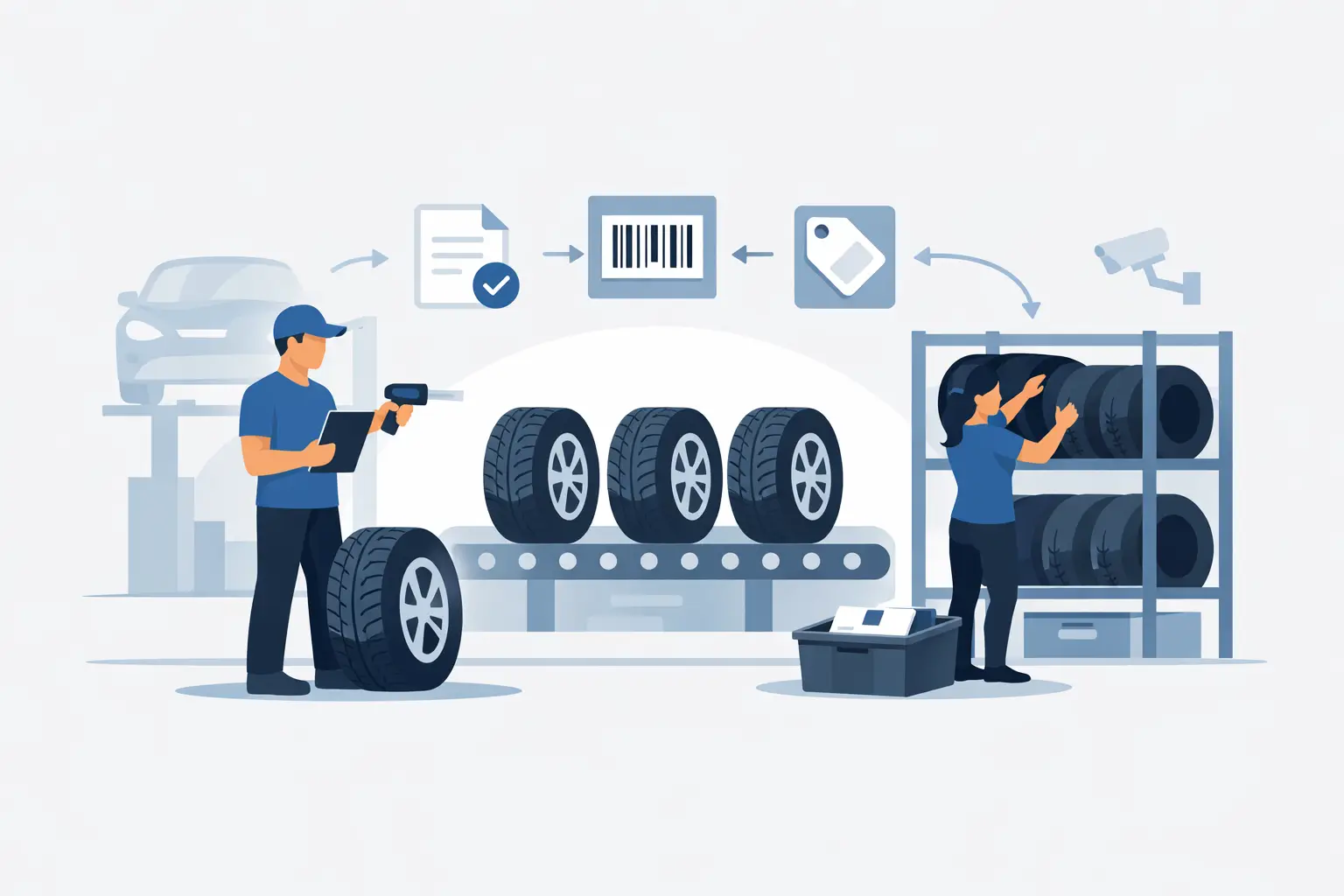
A misplaced tire set costs more than a few minutes of searching. It holds up the service counter, frustrates the customer, and puts pressure on the team during the busiest weeks of spring and fall. A clear tire storage label workflow example gives every stored set an identity from check-in through pickup, so your staff can find it quickly and return the right tires to the right vehicle.
For tire shops, repair garages, and dealership service departments, the label is a small operational tool with a big job. It connects the vehicle, customer, tire details, storage location, and future service needs in one visible place. The best workflow is not complicated. It is consistent enough that every advisor, technician, warehouse worker, and seasonal employee can follow it without guessing.
Why Tire Storage Labels Need a Workflow
A tire storage label works only when it is part of a repeatable process. Writing a customer name on masking tape may get a set onto a rack, but it creates problems when names are misspelled, multiple family vehicles are stored, or tires are moved between locations. A professional label gives the team a standard record that stays with the tires.
The workflow also protects customer confidence. When a customer calls six months later and your staff can confirm the tire brand, size, condition, and storage position, the shop sounds organized. When pickup day arrives, the correct set is ready instead of being located while the customer waits.
There is a trade-off. More information on a label can be useful, but a crowded label is harder to read at a glance. Put the details your staff needs most often on the printed label. Keep deeper inspection notes, repair history, and work-order records in your shop management system.
Tire Storage Label Workflow Example
The following process is designed for seasonal tire storage, but it can be adapted for fleet accounts, dealerships, or shops that store customer wheels and tires year-round.
1. Check in the vehicle before the tires come off
Start at the service counter or intake area. Confirm the customer name, phone number, vehicle year, make, model, and license plate or VIN reference. The license plate is especially useful because it is easy for staff to verify in the parking lot and customers often remember it faster than a tire size.
Create the repair order or storage record before the tires are removed. Assign a storage ID if your system uses one. This can be a simple sequence, such as TS-2026-0148, or a location-based identifier tied to your inventory process. The exact format matters less than using it every time.
If the customer has more than one vehicle or more than one stored set, do not rely on the last name alone. A vehicle identifier prevents mix-ups between similar sets.
2. Inspect and record the tire set
Once the wheels or tires are off the vehicle, have the technician or designated team member verify the set. Record the tire brand, size, and condition. Note whether the tires are mounted on rims, whether there are tire pressure sensors, and whether the set needs attention before the next changeover.
A useful tire storage label should typically include these core fields:
- Customer name and phone number
- Vehicle year, make, model, and license plate
- Tire size, brand, and whether the set is on rims
- Storage ID, date received, and rack or bin location
Depending on your operation, you may also include a tread-depth note, wheel lock key reminder, tire position markings, or an internal barcode. These additions are worthwhile when your staff will actually use them. They are less useful if the information is recorded once and then ignored.
3. Label the set where staff can see it
Apply the label to a clean, dry surface that remains visible after stacking. For bagged tires, place the label on the outside of the bag. For mounted wheel-and-tire sets, many shops use a durable tag or label attached to one tire in the set, with a second matching identifier on the storage rack record.
Avoid placing the only label where it disappears against the wall or floor. Tires shift during storage, and one visible identifier can save time later. If your warehouse stacks sets high or moves them often, two matching labels can be a practical safeguard: one on the set and one on the storage location record.
Printed tire storage stickers are a better fit than handwritten paper when the storage environment includes dust, moisture, cold temperatures, or frequent handling. The goal is simple: the label must still be readable when the customer returns months later.
4. Assign the location immediately
Do not leave stored tires in a temporary area with the intention of assigning a rack later. That shortcut creates the classic problem of a labeled set with no known location. Move the tires to their final rack, pallet, bin, or storage zone and record the location at the same time.
A location system can be as simple as Zone B, Rack 4, Level 2, Position 6. Larger operations may use barcodes and scanners. Either approach can work. A smaller independent shop may be faster with a clear manual system, while a high-volume dealership may need digital tracking to manage hundreds of sets.
The critical rule is that the label record and physical location must match before the vehicle leaves. Build this confirmation into the closeout step of the work order.
5. Confirm the next service need with the customer
Tire storage is also a service retention opportunity. Before checkout, tell the customer where the set is stored and what they may need next season. If the inspection shows uneven wear, low tread, a damaged rim, or a tire nearing replacement, make a clear note in the vehicle record.
This is the right time to use a tire rotation reminder, re-torque label, or seasonal maintenance reminder when applicable. Keep the message specific. Customers respond better to a clear recommended date or mileage interval than a vague instruction to return sometime later.
A storage label should support the conversation, not replace it. The customer does not need every warehouse detail, but they should leave knowing their tires were documented and stored professionally.
Making the Workflow Work During Peak Season
A process that works on a slow Tuesday can break down during the first snowfall or the first warm week of spring. Peak season is when labels matter most because staff are handling a high volume of similar-looking tire sets under time pressure.
Prepare labels before the rush. Keep generic tire storage labels at the service desk, in the tire area, and near the storage racks so no one has to walk across the shop to find supplies. If you use custom labels, make sure the layout has enough room for legible handwriting and the fields match how your team actually works.
Assign ownership at each handoff. The service advisor can confirm customer and vehicle information. The technician can verify tire details and condition. The tire handler or warehouse team can confirm the physical location. In a smaller shop, one person may perform all three steps, but the sequence should remain the same.
A quick end-of-day check helps catch errors before they become expensive. Compare completed storage work orders against the sets placed in storage that day. Look for missing labels, incomplete location fields, or sets sitting in a temporary area. Five minutes of checking is easier than searching through a packed warehouse months later.
Common Problems and How to Prevent Them
The most common storage mistake is using a label with too little identifying information. A customer name alone is not enough, particularly for commercial accounts, families, or repeat customers. Pair the name with a vehicle identifier and storage ID.
Another issue is writing too small or using ink that smears. Your label has to work under shop lighting and from a few feet away. Use a bold, clear handwriting space and a permanent marker suited to the label material. If labels are preprinted with your shop name and contact details, customers also have a direct reminder of where their tires are stored.
Finally, avoid separating the physical label from the digital or paper record. A perfect label cannot help if the rack location is never entered. A detailed computer record cannot help if the tire set has no readable identifier. Both sides of the process need to be completed together.
Choose Labels Built for Real Shop Use
The right tire storage label depends on your storage method, volume, and available record system. A small garage may need a straightforward write-on label with large fields. A busy tire center may benefit from numbered labels that match a warehouse inventory process. Custom printing can add your business name, phone number, logo, and the exact fields your team needs, while stock labels can be a fast, economical option for common workflows.
StickerPlanet Canada produces practical automotive service labels designed for repeat-use shop operations. The focus should always be on readability, durable materials, and a layout that helps your team move vehicles through the service lane without creating extra paperwork.
A good label does not just mark a set of tires. It gives your staff a dependable path from intake to storage to pickup, and it gives customers one more reason to return when the season changes.